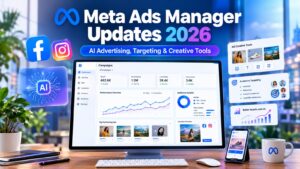
Meta Ads Manager Updates 2026 are important for businesses, marketers, agencies, and advertisers who use Facebook and Instagram to reach customers worldwide. Artificial intelligence, automated campaign optimization, creative generation, audience targeting, and conversion tracking are changing how digital advertising campaigns are managed.
For advertisers, understanding these developments is essential to making informed decisions about campaign budgets, creative testing, audience selection, and advertising performance.
In 2026, Meta continues to expand its AI-powered advertising capabilities and improve tools that help businesses create ads, discover audiences, analyze performance, and manage customer acquisition. However, not every feature is new, and some capabilities may be available only to eligible accounts or through gradual rollouts.
This comprehensive guide explains the key Meta Ads Manager developments, how they affect businesses, and how advertisers can adapt their strategies for better campaign management.
Research cutoff: October 17, 2026. Feature availability and advertising policies may vary by country, account, campaign objective, and rollout status.
Meta Ads Manager Updates 2026: What’s New?
Meta’s advertising platform increasingly combines automation, AI-assisted creative production, audience discovery, and performance measurement. These developments can help advertisers manage campaigns more efficiently, but successful advertising still requires an effective offer, relevant creative, accurate tracking, and a clear business objective.
Meta’s October 6, 2026, Advertising Week announcement highlighted several advertising developments, including Ads Creative Studio, an expanded business AI assistant, Customer Lifecycle Strategy, AI-powered audience discovery planned for later in 2026, and additional AI creative capabilities.
Important Meta Ads developments in 2026
| Feature | Development | What advertisers should do |
|---|---|---|
| Ads Creative Studio | Expanded creative workspace capabilities | Review creative performance and develop new creative concepts |
| Meta AI business assistant | Expanded campaign assistance and creative insights | Evaluate recommendations before making campaign changes |
| AI audience discovery | Natural-language audience discovery announced for later in 2026 | Check availability before changing targeting workflows |
| Customer Lifecycle Strategy | Helps distinguish customer acquisition from existing-customer marketing | Review acquisition objectives and relevant customer exclusions |
| Advantage+ creative | Video generation from existing static assets became generally available | Test suitable product images as video advertisements |
| Product video generation | Additional catalog-related video capabilities, including beta features | Verify eligibility and review generated content |
| Generative Ads Recommendation Model | Meta described further scaling of its AI advertising recommendation technology | Continue measuring campaign performance against business outcomes |
Sources: Meta’s October 2026 advertising announcement and Meta Engineering’s October 13, 2026, article.
These developments do not necessarily represent a complete redesign of Ads Manager. They include new capabilities, expanded rollouts, improvements to existing tools, and features still undergoing testing.
1. Advantage+ and AI-Powered Advertising

Advantage+ is Meta’s collection of automated advertising tools. Depending on the campaign objective and available setup, these tools can help automate campaign delivery, audience discovery, placements, and creative optimization.
The goal is to help Meta’s advertising systems identify opportunities to achieve the advertiser’s selected objective.
How Advantage+ works
Traditional advertising workflows often require advertisers to create multiple ad sets, select audiences manually, configure placements, and test different campaign settings.
With supported Advantage+ setups, advertisers can provide their campaign objective, budget, creative assets, audience guidance, and conversion signals while Meta’s systems optimize delivery.
Advertisers must still make important business decisions, including:
- Choosing the right campaign objective.
- Defining the target market.
- Developing an attractive offer.
- Setting a sustainable budget.
- Providing accurate conversion signals.
- Evaluating the quality and profitability of results.
Automated campaigns versus manual campaigns
Automated campaigns can simplify campaign management and help advertisers use Meta’s optimization systems.
Manual controls can remain useful when a business needs specific geographic restrictions, placement choices, or carefully controlled experiments.
Neither approach is automatically best for every advertiser. The appropriate setup depends on the campaign objective, available data, business requirements, and current platform controls.
Meta AI business assistant developments
In October 2026, Meta announced expanded capabilities for its business AI assistant within Ads Manager.
The assistant is designed to provide more personalized support and connect creative insights with campaign planning.
Some additional campaign-management capabilities, including conversational campaign actions and budget adjustments, were being tested rather than universally released as of October 17, 2026.
Advertisers should distinguish between recommendations, draft changes, approved changes, and published campaigns. Human review remains important for budget decisions, brand accuracy, and policy compliance.
2. Changes in Meta Ads Audience Targeting
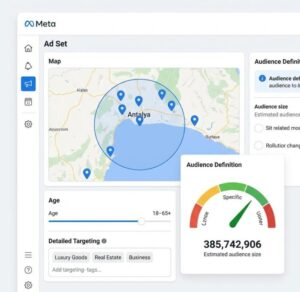
Audience targeting remains an important part of Meta advertising, but automated delivery and AI-based recommendations are changing how advertisers approach audience selection.
Advantage+ audience
Advantage+ audience can use advertiser-provided audience suggestions alongside Meta’s delivery systems to identify people who may be more likely to complete the desired action.
Depending on the campaign, some inputs may guide optimization without acting as strict boundaries. Other settings can establish restrictions that delivery must respect.
The exact controls available depend on the campaign type and objective.
Audience suggestions versus audience controls
Audience suggestions communicate the type of person an advertiser believes may respond to an advertisement.
Audience controls establish restrictions where supported, subject to the available campaign settings and applicable policies.
For example, a business that provides services only in Canada should configure its campaign to reflect its actual service area. Audience suggestions should not replace required geographic restrictions.
Custom Audiences and Lookalike Audiences
Custom Audiences can help advertisers reach eligible people based on permitted customer data, website activity, app activity, or engagement.
Lookalike Audiences can help identify people similar to a source audience where the feature is available and permitted.
These tools can support prospecting and retargeting, but their effectiveness depends on data quality, audience size, campaign eligibility, and privacy requirements.
AI-powered audience discovery
Meta announced AI-powered audience discovery for Detailed Targeting in October 2026, with availability planned for later in the year.
The proposed capability allows advertisers to describe an ideal audience using natural language and review suggested audiences before deciding which to use.
As of October 17, 2026, this should be treated as an announced future capability rather than a feature guaranteed to be available in every account.
How advertisers should adapt
- Define the ideal customer using genuine customer research.
- Configure appropriate geographic and other campaign restrictions.
- Test automated audience delivery where suitable.
- Use customer data only when its collection and advertising use are permitted.
- Compare qualified conversions rather than reach or clicks alone.
- Review targeting settings whenever campaign objectives or platform controls change.
Traditional interest targeting may still be useful, but adding more interests does not automatically improve campaign performance.
3. AI Creative Tools and Advertising Formats
,
Creative quality influences whether an advertisement attracts attention, communicates value, and motivates action.
Meta’s 2026 developments increasingly focus on helping businesses create, analyze, and adapt advertising creative more efficiently.
Ads Creative Studio
On October 6, 2026, Meta announced a broader rollout of Ads Creative Studio, a workspace designed to help marketers understand creative performance and develop new creative concepts.
For example, a software company might discover that a short product demonstration generates more qualified leads than a generic promotional graphic. That insight can guide its next creative test.
Advertisers should interpret creative performance in context because audience selection, budget, placements, and campaign objectives can affect results.
Turning static images into video advertisements
Meta announced that video generation from existing static assets in Advantage+ creative was generally available as of October 6, 2026.
This capability can help businesses test video-style advertising without starting every production project from scratch.
An e-commerce company might adapt product photographs into short promotional videos. A service provider might develop a visual sequence explaining a customer problem, its solution, and the next step.
AI-generated content should still be checked for accuracy, readability, product representation, and brand consistency.
Product catalog video generation
Meta also described capabilities for creating videos from product catalog images at scale. Some catalog-related video capabilities were available through beta features for eligible advertisers.
Businesses should verify their account’s eligibility and distinguish generally available tools from beta access.
Creative testing strategies
Instead of producing many superficial variations of the same advertisement, test distinct creative concepts.
For example, a B2B software company could test:
- A product demonstration.
- A customer problem-and-solution concept.
- A feature comparison.
- A founder-led explanation.
- A clear offer addressing a specific business need.
Each creative should communicate truthful claims and direct users to a relevant landing page.
Reels, Stories, and Feed advertising
Vertical video can be effective for mobile-first placements, while Feed and other placements may suit different creative formats.
Advertisers should consider the intended placement when designing creative assets.
Use readable text, clear messaging, captions where appropriate, and a visible call to action.
The goal is not simply to create more AI-generated content. It is to develop relevant, accurate creative that helps the intended audience understand the offer.
4. Lead Generation Campaign Updates

Lead generation is important for digital marketing agencies, consultants, B2B companies, real estate businesses, education providers, and many service businesses.
However, a low cost per lead does not necessarily indicate a successful campaign. Leads must be relevant, reachable, and capable of becoming customers.
Customer Lifecycle Strategy
One of Meta’s important October 2026 developments was the general availability of Customer Lifecycle Strategy.
The feature helps advertisers identify campaigns intended to acquire new customers and receive recommendations for excluding existing customers.
This can help businesses distinguish customer acquisition from retention activities.
For example, a company seeking new customers may want to prioritize qualified prospects, while a separate campaign may focus on repeat purchases, renewals, or cross-selling.
Advertisers should review the recommendations and ensure that customer data is accurate and eligible for advertising use.
Instant Forms and lead qualification
Meta lead ads allow users to submit information through forms on supported placements.
Depending on availability, advertisers may use form questions and higher-intent workflows to improve lead quality.
Forms should request only the information needed for the business purpose. Too many questions can discourage legitimate prospects, while insufficient qualification can produce irrelevant inquiries.
For a marketing agency, useful qualification questions might concern the business type, primary advertising objective, target market, and project requirements.
Conversion Leads and CRM feedback
Where supported, Conversion Leads optimization can help advertisers optimize for leads that meet downstream quality criteria rather than only initial form submissions.
This requires reliable lead-status information and an appropriate integration or feedback mechanism.
A practical workflow is:
- A prospect submits a lead form.
- The CRM records the lead and source.
- The sales team contacts the prospect.
- The business updates the lead’s qualification status.
- Eligible lead-quality signals are shared through a supported integration.
- Campaign performance is evaluated using qualified leads and actual sales.
Check current Meta documentation before assuming a particular integration or optimization goal is mandatory for your account.
Lead generation example
Suppose a real estate business advertises properties in a specific service area.
Instead of optimizing only for inexpensive form submissions, it should evaluate:
- Whether the prospect is interested in the advertised property type.
- Whether the person can be contacted.
- Whether the location and budget match the available inventory.
- Whether an appointment or qualified sales conversation occurs.
- How much advertising spend is required to generate a genuine opportunity.
The same principle applies to agencies, consultants, and B2B businesses: measure lead quality and commercial value, not just the number of form submissions.
Businesses that need help with campaign structure, lead-generation funnels, landing pages, or conversion measurement can explore the services offered by 2 NICE LIFE.
5. Meta Pixel, Conversions API, and Tracking
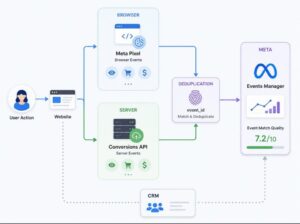
Advertising optimization depends on the quality of the signals available to the platform. Inaccurate or incomplete conversion tracking can make it difficult to understand actual campaign performance.
The Meta Pixel, Conversions API, and a business’s own analytics or CRM records each play an important role.
What is Meta Pixel?
The Meta Pixel is a browser-based tool that can record eligible website events, subject to implementation, consent requirements, browser behavior, and applicable policies.
Depending on the setup, these events may include product views, lead submissions, checkout activity, or purchases.
The Pixel can help connect website activity with advertising measurement and optimization.
What is Conversions API?
The Conversions API allows supported systems to send eligible events to Meta from a server or another supported integration.
It can complement browser-based tracking and help businesses transmit relevant conversion information when implemented correctly.
It does not automatically guarantee complete measurement or eliminate privacy obligations.
Browser and server event deduplication
When the same eligible event is sent through browser and server integrations, event deduplication may be necessary to prevent the same conversion from being counted twice.
A proper implementation should verify event names, identifiers, timestamps, matching quality, consent handling, and the relationship between recorded events and actual transactions.
Conversion tracking checklist
- Confirm that the correct Pixel or dataset is connected.
- Check whether the intended events fire at the right time.
- Verify purchase values and currencies where relevant.
- Review duplicate event handling.
- Test the Conversions API integration if used.
- Compare Meta reports with CRM, sales, and analytics records.
- Investigate significant differences instead of assuming one platform is always correct.
Attribution windows and reporting methodologies can affect the number of conversions attributed to advertising. Meta’s reported results may therefore differ from a business’s internal records.
Businesses should document the measurement methods used to evaluate performance and avoid comparing incompatible reporting windows.
6. Campaign Budgets, Bidding, and Optimization
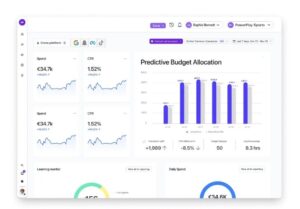
A campaign budget determines how much a campaign can spend, while bidding and optimization settings influence how the advertising system pursues the selected objective.
These concepts remain important even as AI automates more campaign decisions.
Campaign budget versus ad set budget
A campaign-level budget can allow Meta to allocate spending among eligible ad sets according to the campaign’s setup and optimization logic.
An ad set-level budget provides more direct spending allocation at that level.
The appropriate choice depends on whether the advertiser wants the system to distribute spending or needs more control over how different audiences or tests receive budget.
Daily and lifetime budgets
A daily budget represents an intended average daily spending level under the applicable delivery rules.
A lifetime budget establishes a spending limit for the campaign or ad set over its scheduled period.
Review the budget type, schedule, billing information, and account-level spending controls before launching a campaign.
Bidding strategies
Available bidding options depend on the campaign objective and current Ads Manager setup.
A business focused on volume may use different settings from one with a strict cost target or a need to prioritize conversion value.
The key is to align bidding with the business objective and the reliability of the available conversion signals.
Understanding the learning phase
When a campaign or ad set is learning, the delivery system is gathering information to optimize performance.
Significant edits can affect delivery or trigger renewed learning, depending on the circumstances.
Avoid making frequent changes based on limited data. Define a testing period, track the appropriate outcome, and make adjustments when the evidence supports them.
Calculate acceptable acquisition costs
A business should establish its maximum sustainable customer acquisition cost using its own economics.
A low-margin product business cannot evaluate advertising in the same way as a business selling a high-value recurring service.
Before increasing spending, consider gross margin, refunds, fulfillment expenses, customer lifetime value, and other operating costs.
Higher advertising spend does not automatically produce proportionally higher revenue or profit.
7. Meta Ads Reporting and Performance Measurement
Campaign metrics are useful when they explain what is happening and help advertisers decide what to do next.
They are less useful when viewed in isolation.
Important Meta Ads metrics
| Metric | Meaning | How to use it |
|---|---|---|
| CPM | Cost per 1,000 impressions | Understand the cost of reaching an audience |
| CTR | Click-through rate under the selected metric | Assess clicks relative to impressions |
| CPC | Cost per click under the selected reporting definition | Monitor the cost of generating traffic |
| Cost per lead | Advertising spend divided by attributed leads | Compare lead acquisition costs |
| Conversion rate | The proportion of relevant visitors or users who convert | Evaluate the effectiveness of the funnel |
| CPA | Cost per acquisition or specified action | Assess the cost of achieving the desired outcome |
| ROAS | Attributed revenue divided by advertising spend | Evaluate reported advertising revenue relative to spend |
| Frequency | Average number of times people were shown an ad | Monitor exposure and possible creative fatigue |
| Video-view metrics | Defined measures of video viewing and engagement | Understand how people interact with video assets |
Always check the precise definition of a metric in Ads Manager. Different CTR columns, for example, can measure different types of clicks.
Why ROAS is not the same as profit
Suppose an online store spends $1,000 on advertising and reports $3,000 in attributed revenue. Its reported ROAS is 3.0.
That does not automatically mean the campaign generated $2,000 in profit.
The business still needs to account for product costs, shipping, payment processing, refunds, taxes where applicable, and other operating expenses.
Similarly, a lead-generation campaign with a low cost per lead may perform poorly if most leads never become customers.
Evaluate the complete funnel
For a service business, a useful reporting chain is:
Impressions → Clicks → Landing-page visits → Leads → Qualified leads → Sales → Revenue.
This helps identify where the main problem occurs.
Low click-through rates may suggest a creative or offer issue. Strong traffic with few leads may indicate a landing-page or audience mismatch. Many leads but few sales may point to poor qualification, weak follow-up, or an unsuitable offer.
Not every problem can be fixed by changing targeting.
8. Privacy, Compliance, and Advertising Policies

Meta advertisers serving international audiences must consider the platform’s advertising policies and the legal requirements applicable to their business and audience.
Rules can differ across jurisdictions and may be stricter for particular industries.
Responsible customer data use
Businesses should:
- Collect only information needed for a legitimate purpose.
- Provide appropriate privacy notices.
- Obtain consent when required.
- Use customer data only in permitted ways.
- Protect access to CRM and advertising accounts.
- Review requirements for uploading customer lists.
- Honor applicable data rights and deletion requests.
- Configure tracking technologies appropriately.
The availability of a technical integration does not mean every use of that integration is legally permitted.
Special Ad Categories and restricted content
Certain housing, employment, financial, political, and other sensitive advertising contexts may have additional requirements or targeting restrictions.
The exact requirements depend on the ad category, market, and applicable policies.
Advertisers should review current official rules before launching campaigns in regulated categories.
AI-generated creative compliance
AI-generated creative must still comply with advertising policies and applicable laws.
Do not use AI to fabricate testimonials, misrepresent product capabilities, create misleading before-and-after results, or imply that a person endorses a product without authorization.
Review generated images, videos, translations, claims, and landing pages before publishing an advertisement.
9. How to Adapt Your Meta Advertising Strategy in 2026
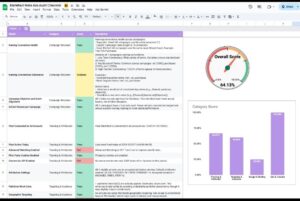
A practical adaptation plan focuses on fundamentals first and new features second.
Step 1: Audit existing campaigns
Review campaign objectives, budgets, audiences, placements, creative assets, and conversion events.
Identify which campaigns produce qualified leads or profitable sales rather than inexpensive clicks alone.
Step 2: Review campaign setup
Check whether the campaign objective matches the outcome you want.
A campaign designed for traffic should not be assumed to optimize for the same business results as one configured for qualified leads or purchases.
Step 3: Test available automation
Review the Advantage+ features offered for your campaign. Test automated delivery where appropriate and retain the controls required for your business.
Do not rebuild every campaign solely because a new feature has been announced.
Step 4: Refresh creative assets
Develop new concepts based on customer questions, objections, product benefits, and real performance data.
Where available, test AI-generated video from static assets, but inspect every variation before use.
Step 5: Check targeting controls
Verify geographic restrictions, audience settings, exclusions, and applicable category requirements.
If using Customer Lifecycle Strategy, check that the acquisition objective and existing-customer data reflect the intended campaign.
Step 6: Audit tracking
Test Pixel events and any Conversions API integration. Confirm that the events used for optimization correspond to meaningful business actions.
Step 7: Measure lead quality
Connect advertising data with sales or CRM outcomes where possible.
Review the proportion of leads that qualify, attend appointments, or become customers.
Step 8: Run controlled experiments
Change one major variable at a time where practical. Keep the objective and measurement method consistent enough to interpret the result.
Allow sufficient time and data for meaningful comparisons.
Step 9: Compare cost and value
Assess cost per qualified lead, acquisition cost, revenue, margin, and customer value where available.
Do not scale spending merely because a campaign’s click-through rate has improved.
Step 10: Document and optimize
Keep a record of campaign changes, creative tests, tracking issues, and outcomes.
This creates a reliable basis for future decisions and helps teams understand what has already been tested.
Meta Ads Manager audit checklist
- [ ] Campaign objective matches the business goal.
- [ ] Budget and schedule are correct.
- [ ] Audience controls reflect the actual service area.
- [ ] Advantage+ settings have been reviewed.
- [ ] Creative assets are accurate and suitable for placements.
- [ ] Landing pages work on mobile and desktop.
- [ ] Pixel events have been tested.
- [ ] Conversions API is configured correctly if used.
- [ ] Duplicate events have been checked.
- [ ] Lead quality and sales outcomes are measured.
- [ ] Relevant advertising policies have been reviewed.
- [ ] Results are compared using a consistent methodology.
Need help implementing these changes? Explore 2 NICE LIFE for digital marketing services related to advertising strategy, PPC, lead generation, landing pages, and conversion measurement.
10. Common Meta Ads Manager Mistakes to Avoid
Assuming every announced feature is available
A feature announced by Meta may be in testing, rolling out gradually, or limited to eligible accounts. Check the options available in your own account.
Trusting automation without reviewing results
Automation can help optimize delivery, but it cannot replace a clear business objective, accurate tracking, or sound commercial judgment.
Changing too many variables at once
Changing the audience, creative, budget, landing page, and optimization event simultaneously makes it difficult to identify what caused a result.
Optimizing only for cheap leads
A low-cost lead may have little commercial value if the person is not qualified or cannot be converted into a customer.
Ignoring creative fatigue
Repeated exposure to the same creative may reduce effectiveness. Monitor performance and test new concepts when the evidence indicates a problem.
Misreading attribution
Attributed conversions are not necessarily identical to incremental conversions or total business sales. Use clear measurement definitions and compare platform reporting with appropriate internal records.
Ignoring privacy and policy requirements
Incorrect data handling or non-compliant creative can create legal, operational, and account risks.
Scaling before checking profitability
Before increasing budgets, evaluate the business economics and whether the campaign is producing sustainable results.
11. Meta Ads Manager Updates 2026: Frequently Asked Questions
What is new in Meta Ads Manager in 2026?
Among the major developments announced by October 17, 2026, are the broader rollout of Ads Creative Studio, expanded business AI assistant capabilities, Customer Lifecycle Strategy, and generally available video generation from existing static assets in Advantage+ creative. Additional AI campaign-management functions remain in testing.
Has Meta Ads Manager changed its interface?
Meta continues to introduce and expand tools within its advertising workflow. However, these updates do not establish that every advertiser has received a complete interface redesign. The controls visible to you may depend on campaign type, account eligibility, and rollout status.
What is Advantage+ in Meta Ads Manager?
Advantage+ is Meta’s collection of automated advertising tools. Depending on the campaign, it can help optimize delivery, placements, audience discovery, or creative combinations. Advertisers should review available controls and assess results against actual business objectives.
Is manual targeting still available?
Some manual audience controls and targeting options remain available, but the options depend on campaign type, market, and applicable restrictions. Automated audience suggestions should not be confused with firm targeting controls.
How is AI changing Facebook and Instagram advertising?
AI is increasingly involved in ad delivery, creative production, campaign recommendations, and audience discovery. Advertisers can use these tools to improve efficiency, but they still need accurate information, relevant creative, sound offers, and reliable measurement.
What is the difference between Meta Pixel and Conversions API?
The Meta Pixel can collect eligible browser-based website events, while Conversions API supports sending eligible events from a server or another supported integration. They can complement one another, but implementation, deduplication, consent, and data quality must be handled correctly.
How can businesses improve lead quality?
Improve the match between the audience, offer, form, and sales process. Use relevant qualification questions, respond promptly, track lead outcomes, and evaluate cost per qualified lead rather than focusing exclusively on form submissions.
Are Meta Ads Manager updates available worldwide?
Not necessarily. Some capabilities are generally available, while others roll out gradually or remain restricted to selected markets, accounts, or beta participants. Check official announcements and the controls in your account.
How can I track Meta ad conversions accurately?
Test the relevant Pixel events, review Conversions API implementation if used, verify deduplication, and compare attributed results with appropriate CRM or transaction records. Ensure tracking respects applicable privacy requirements.
What is the best Meta Ads campaign setup for a small business?
There is no single setup that works for every business. Start with a clear objective, a relevant offer, a suitable budget, accurate conversion tracking, and creative that communicates value. Test automation and manual controls where appropriate, then optimize using meaningful outcomes.
How often should advertisers review their campaigns?
Review campaign delivery and spending regularly, with the frequency based on budget, volume, and business risk. Avoid reacting to every short-term fluctuation. Use a consistent review schedule and make significant changes when enough evidence is available.
When should a business hire a Meta Ads specialist?
Professional support may be useful when campaigns are difficult to measure, lead quality is poor, costs are rising, conversion tracking is unreliable, or the business needs a structured testing and optimization process. Choose a provider based on transparent reporting, relevant expertise, and realistic expectations.
Conclusion: Preparing for the Future of Meta Advertising
The most important Meta Ads Manager developments in 2026 reflect a broader shift toward AI-assisted campaign management, creative production, and audience discovery.
Meta’s October announcements are especially relevant to advertisers who want to produce more creative variations, understand performance more effectively, and distinguish customer acquisition from existing-customer marketing.
However, adopting every new feature is not a strategy in itself.
Businesses still need a compelling offer, relevant creative, accurate tracking, responsible data practices, and a clear understanding of their customer acquisition economics.
The strongest approach is to review the features actually available in your account, test meaningful improvements, and measure the impact on qualified leads, sales, and profitability.
If your business needs help with Meta advertising, PPC, lead generation, conversion tracking, or landing-page optimization, explore the services available at 2 NICE LIFE — Your Growth Partner.
Build your advertising strategy around evidence, not hype, and use automation where it supports your business goals.
Authoritative Sources
- Meta — Advertising Week New York, October 2026: https://about.fb.com/ltam/news/2026/10/advertising-week-new-york-2026-nuevas-capacidades-de-ia-para-guiar-campanas-y-llegar-a-los-clientes/
- Meta Engineering — Generative Ads Recommendation Model, October 13, 2026: https://engineering.fb.com/2026/10/13/ml-applications/generative-ads-model-gem-scaling-frontier-ads-ai/
- Meta for Business — Reels advertising: https://www.facebook.com/business/ads/facebook-instagram-reels-ads
- Meta Newsroom — AI and advertising performance: https://about.fb.com/news/2026/01/2026-ai-drives-performance/