
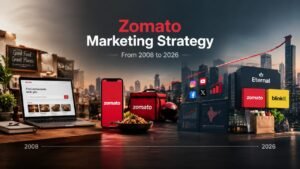
Understanding the complete Zomato Marketing Strategy reveals how the brand evolved from 2008 to 2026. Zomato did not become one of India’s most recognizable consumer internet brands through a single campaign or channel. It did so by repeatedly aligning product reality with cultural conversation, treating marketing as an extension of the user experience rather than a separate cost center, and iterating aggressively when strategies broke.
1. Origin & Early Positioning (2008–2012)
Deepinder Goyal and Pankaj Chaddah, IIT Delhi graduates working at Bain & Company, noticed colleagues repeatedly hunting for physical restaurant menus. They scanned and uploaded menus, first internally, then as Foodiebay in July 2008 in Delhi. The original model was a free restaurant directory and menu aggregator. Target audience: urban professionals seeking convenience and information. Value proposition: accurate, searchable menus and basic discovery where none existed digitally.
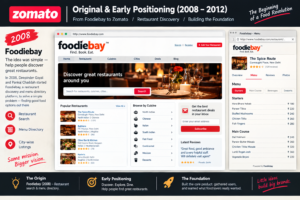
Early acquisition was organic and manual—founders and early team collected menus door-to-door. Differentiation came from data accuracy and completeness rather than flashy advertising. Channels were the website itself, SEO for local restaurant queries, and word-of-mouth. Restaurants began approaching for advertising once traffic appeared, creating the first monetization loop. In 2010 the name changed to Zomato (to avoid eBay conflict and signal broader ambitions), Info Edge invested, and a mobile app launched. Positioning remained functional: the most reliable place to find what to eat.
2. Brand Positioning Evolution
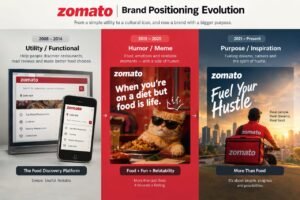
Early brand promise: “Find restaurants and menus easily.” Personality was neutral and utility-focused. Visual identity and tone shifted as the product expanded.
By the mid-2010s, as delivery launched, positioning moved toward convenience and variety. From roughly 2017 onward the brand deliberately adopted a witty, irreverent, millennial-friendly voice—more friend than corporation. This was a conscious pivot away from glossy food photography toward cultural commentary. Later campaigns (“Har Customer Hai Star,” “Fuel Your Hustle”) layered reliability and purpose onto the humor foundation. Against Swiggy, Zomato leaned harder into distinctive brand voice while Swiggy emphasized integrated utility and reliability. The 2025 Eternal parent rebrand clarified corporate multi-vertical identity without diluting the Zomato consumer brand.
3. Complete Marketing Strategy by Channel
Digital & SEO: Massive restaurant listing directory powered long-tail local SEO (“best biryani near me”). High organic visibility reduced early CAC.
Social media & content: Signature channel. Short, conversational, opinionated posts; heavy meme and newsjacking use. Target: 18–35 urban users.
Psychology: belonging, shared humor, attention in a noisy feed. Impact: top-of-mind awareness at relatively low cost; engagement rates frequently cited as multiples of category norms.
Performance & paid: Google/Facebook/app install campaigns scaled with delivery growth. Later shifted toward converting existing intent rather than pure demand creation (marketing head comments in 2026).
Influencer & partnerships: Food bloggers, regional creators, cricket/Bollywood talent for reach and cultural fit.
App, push, email, CRM: Highly personalized notifications (“Your favorite biryani misses you”), order history, location, and time-of-day triggers. Strong habit-formation tool.
Referral & loyalty: Early referrals; later Gold/Pro iterations for retention and higher frequency.
Offline/PR/events: Billboards, IPL topical work, founder communication, values announcements (period leave). Real-time social often amplified offline moments.
Viral & community: User-generated meme participation and cultural ownership of the brand voice.
Each channel served a clear objective—awareness via social, conversion via performance and offers, retention via personalization and membership—while the brand voice remained consistent.
4. Content Marketing Strategy
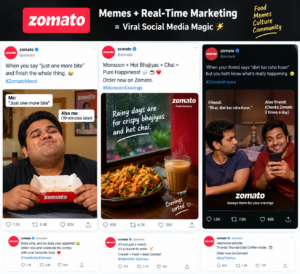
Zomato’s content is recognizable for brevity, cultural fluency, self-deprecation, and speed. Festival, cricket, Bollywood, and news moments are treated as content opportunities within hours. Copy is conversational, often a single strong opinion or pun. Visuals favor simple, shareable formats over polished production in organic posts. Recurring principles: talk like a witty friend, own the cultural moment, never sound corporate, and let the product (food, convenience) sit lightly in the background. This built distinctive brand equity that performance marketing alone cannot buy.
5. Viral Marketing & Customer Psychology
Humor lowers resistance and increases shareability. Curiosity and novelty keep feeds interesting. FOMO and scarcity appear in limited offers and peak-hour messaging. Social proof comes from reviews, ratings, and visible order volume. Convenience and habit formation are product-led but reinforced by timely notifications. Personalization creates reciprocity and perceived understanding. Identity and status play appears in membership tiers and “every customer is a star” framing. Loss aversion surfaces in free-delivery thresholds and delay guarantees. Zomato applied these not as abstract theory but as daily operational content and product decisions.
6. Major Marketing Campaigns
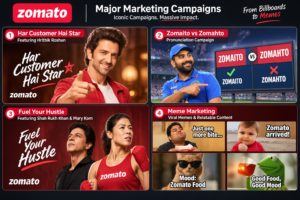
Meme & topical social (ongoing from ~2017): Objective—engagement and top-of-mind. Real-time cultural commentary. High shareability; built the “witty friend” identity.
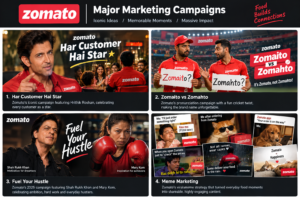
Har Customer Hai Star (2021–2022): Featuring celebrities treating everyday customers and delivery partners as stars. Objective—reliability and emotional connection during competitive pressure. Mixed reception on gig-economy portrayal.
Pronunciation / “Zomaito vs Zomahto” and cricket plays (2023–2024): Playful ownership of brand name debates with cricketers. Light, cultural, high recall.
Fuel Your Hustle (2025 onward): Featuring Shah Rukh Khan, AR Rahman, Mary Kom, Jasprit Bumrah and later para-athletes. Shift to purpose and grit. Black-and-white aesthetic. Objective—elevate brand beyond convenience to enabler of ambition. Marked creative direction change.
Publicly disclosed quantitative results for most campaigns are limited; success is inferred from sustained brand recognition and cultural conversation share.
7. Branding & Copywriting Analysis
Copy favors short sentences, everyday language, cultural references, and mild irreverence. Headlines and CTAs are direct yet playful. Timing (real-time) often matters more than perfect polish. The underlying formula is: observe cultural moment → add food/delivery angle with humor or opinion → keep brand voice consistent → end with soft product invitation. This produces high engagement without sounding salesy.
8–9. Customer Acquisition & Retention
Early: Organic SEO, word-of-mouth, restaurant-driven discovery.
Growth/hyper-growth: Heavy paid installs, discounts, referrals, restaurant density network effects.
Post-IPO: Efficiency focus; discounts increasingly used to convert intent rather than manufacture it.
Retention: Personalization, recommendations, push notifications, membership benefits (free delivery thresholds, priority), convenience and selection. Habit loops around time-of-day and cuisine preferences. Data from order history and location powers relevance.
10. Zomato Gold / Loyalty Evolution
Launched 2017 as dine-in focused (1+1 offers). Evolved to Pro (2020) adding delivery benefits, then Pro Plus, then suspended amid restaurant resistance (NRAI #LogOut campaign). Relaunched 2023 as Gold with free delivery above thresholds, delay compensation, and peak access. Objective: higher frequency and retention. Psychology: sunk-cost membership + tangible savings. Pricing started introductory (e.g., ₹149 for three months). Lessons: balance customer value with restaurant economics; iterate publicly.
11. PR & Brand Communication
Founder-led transparency (shareholder letters, blogs), values announcements (period leave), and rapid social response shaped perception. Controversies (discount pressure on restaurants, delivery-partner issues, pure-veg mode debates) were often met with public explanation or product adjustment. Crisis communication tended toward acknowledgment plus action rather than pure deflection.
12. Competitive Marketing Analysis
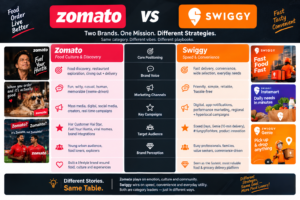
Versus Swiggy: Zomato emphasized distinctive, humorous brand voice and cultural ownership; Swiggy leaned into reliability, integrated super-app utility (Instamart + One membership), and performance scale. Both use discounts, influencers, and cricket, but Zomato’s content identity is more differentiated. Historical competitors (Foodpanda, Uber Eats India) were largely absorbed or exited, reinforcing the duopoly.
13–14. Business Model Connection & Data/Personalization
Marketing supports the multi-sided platform: user growth drives restaurant advertising and commission revenue; restaurant density improves selection and conversion; delivery-partner supply enables experience. Membership and advertising are direct monetization levers. Publicly, personalization draws on order history, location, search, and behavior for recommendations and notifications. Exact algorithms are proprietary; the strategic outcome is higher relevance and frequency.
15. Zomato + Blinkit / Quick Commerce & Eternal
2022 acquisition brought higher-frequency grocery use cases, shared logistics potential, and new customer segments. Brand architecture kept separate apps/brands (super-brands approach versus Swiggy’s super-app). Cross-promotion opportunities exist but require careful execution to avoid dilution. Parent rebrand to Eternal Limited (March 2025) signals multi-vertical identity (Zomato, Blinkit, Hyperpure, District) while consumer-facing brands stay specialized. Marketing opportunity: increased wallet share and habit density; risk: brand stretch and complexity.
16. Financial & Growth Context (Selected)
IPO 2021 provided capital for growth and marketing. Path from deep losses to improving adjusted EBITDA and eventual profitability reflected unit-economics focus and scale. FY25 revenue growth and order volumes illustrate the combined food + quick-commerce engine. Marketing spend remains material but is increasingly precision-oriented.
17. What Zomato Did Right (Top Strategic Marketing Decisions)
1.Obsessive early data accuracy → trust foundation.
2.Rebrand and mobile-first move → future-proofing.
3.Deliberate adoption of humorous, cultural voice → distinctive equity.
4.Real-time content capability → low-cost relevance.
5.Delivery entry timed with smartphone growth.
6.Loyalty iteration despite setbacks.
7.Celebrity + everyday-hero campaigns for emotional scale.
8.Blinkit for frequency and defensibility.
9.Shift from demand-creation discounts to intent conversion.
10.Purpose layer (“hustle”) without abandoning humor roots.
18. What Zomato Did Wrong / Challenges
Restaurant partner friction over deep discounts and Gold terms led to organized pushback. Some campaigns drew criticism for glamorizing gig work without addressing pay/conditions. Over-reliance on promotions at times trained price sensitivity. International expansion was largely reversed. Pure-veg mode and other product-comms moments created temporary polarization. These were real costs in trust and economics that required correction.
19. Zomato Marketing Strategy : Turning Points
Name change 2010; delivery launch; social-voice pivot ~2017; Gold controversies; IPO and mass campaigns; Blinkit deal; creative shift to “hustle”; Eternal rebrand. Each forced or enabled a marketing recalibration.
20. Marketing Funnel Breakdown
Awareness (social memes, PR, TV/digital brand) → Interest (content, cultural relevance) → Consideration (SEO, reviews, ads) → Install (performance, referrals) → First order (offers, onboarding) → Second/repeat (notifications, personalization, free-delivery thresholds) → Loyalty (Gold) → Advocacy (shareable content, membership status). Psychology and messaging tighten at each stage from curiosity to habit to identity.
21–23. STP, 7Ps, SWOT (Marketing-Focused)
STP: Early broad urban discovery seekers → later hyper-segmented by cuisine, frequency, location, and membership propensity. Positioning: from directory to witty convenience companion to ambition enabler.
7Ps: Product (selection + speed + personalization); Price (dynamic, membership, commissions); Place (app + dense network); Promotion (humor + performance + purpose); People (delivery partners as brand face); Process (tracking, reliability); Physical evidence (app UX, packaging, partner appearance).
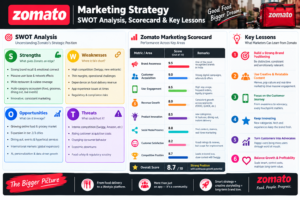
SWOT (marketing lens): Strengths—brand voice, cultural fluency, data; Weaknesses—partner tensions, promotion dependency risk; Opportunities—cross-vertical frequency, purpose storytelling; Threats—Swiggy/others matching content or outspending on performance, regulatory/gig issues.
24. Marketing Moat
Brand equity and distinctive voice are hard to copy quickly. Habit + data network effects, restaurant density, and content identity create compounding advantages. Technology and logistics scale raise the bar further.
25. Current Marketing Strategy — 2026
As of late 2025–2026 reporting and commentary: balanced performance acquisition with brand investment at category peaks; discounts as precision conversion tools; continued cultural and purpose content (“hustle” extensions); multi-brand architecture under Eternal; focus on frequency across food and quick commerce. Positioning remains convenience-plus-personality with an added layer of aspiration. Competitive environment is intense in both food delivery and quick commerce.
26. Future Strategy (Analysis, Not Prediction)
Opportunities lie in deeper personalization, cross-vertical journeys, and purpose authenticity. Risks include brand dilution, rising CAC if content advantage erodes, and external regulatory or labor pressures. Emerging trends (value consciousness, health, sustainability) will require product-marketing alignment.
27. Lessons for Small Businesses
Copy the principles, not the budget: develop a consistent, human voice; master one or two channels deeply; use real-time cultural moments; prioritize retention data and simple loyalty; treat partners (restaurants, delivery) as brand co-owners. High-production celebrity work and national performance scale require resources most small businesses lack. Local SEO, authentic social, and referral loops are realistic starting points.
28. Marketing Strategy Scorecard (out of 10)
Branding: 9 – distinctive and evolved.
Content marketing: 9.5 – culturally owned.
Social media: 9.5 – category-defining.
Performance marketing: 8 – matured to efficiency.
Customer acquisition: 8.5 – scaled effectively.
Customer retention: 8 – membership + personalization.
SEO: 8.5 – foundational strength.
PR: 8 – transparent and values-aware.
Customer psychology: 9 – applied daily.
Innovation: 8 – iterative product-marketing.
Community building: 8 – content-driven.
Brand differentiation: 9 – clear versus peers.
Marketing consistency: 8.5 – voice held across eras.
Overall: 8.7 – one of India’s strongest consumer-internet marketing engines.
29. Final Strategic Verdict
Zomato became a recognizable brand because it treated marketing as continuous cultural participation rather than periodic advertising, because it built product experiences that the content could honestly celebrate, and because it iterated publicly when strategies failed. The core principles are: own a distinctive voice early; make content serve both brand and product; align incentives across the multi-sided platform; use data for relevance, not just targeting; and evolve positioning as the business expands without abandoning what made the brand lovable. Modern marketers can extract the operating system—speed, cultural fluency, retention focus, and honest iteration—regardless of category or scale.
FAQ Section
What was Zomato’s original name and business model?
How did Zomato’s brand voice develop?
What are Zomato’s most notable marketing campaigns?
How has Zomato Gold evolved?
How did Blinkit change Zomato’s marketing?
What can small businesses learn from Zomato’s strategy?
3 Responses