
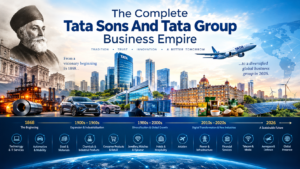
Table of Contents
- Executive Summary
- Understanding the Tata Group
- Tata Sons vs Tata Group vs Tata Trusts
- How Tata Ownership Works
- History of the Tata Group: 1868–2026
- Major Tata Group Companies
- Tata Companies by Sector
- Tata Brands and Products
- Subsidiaries, Associates and Joint Ventures
- Tata Trusts and Philanthropy
- How Tata Businesses Make Money
- Financial Performance and Market Capitalisation
- Major Acquisitions and International Expansion
- Tata Digital, Tata Neu and Consumer Businesses
- Semiconductors, Electronics, EVs and Emerging Businesses
- Leadership and Corporate Governance
- Competition and Market Position
- Common Misunderstandings About Tata
- Company and Brand Coverage Register
- FAQs
- Conclusion
- Sources and Further Reading
- Suggested Images and Internal Links
- Digital Growth Support by 2 NICE LIFE
1.Executive Summary
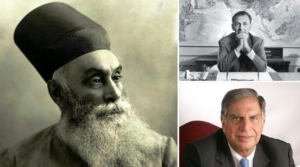
The Tata Group is one of India’s oldest and most diversified business groups. Its origins date back to 1868, when Jamsetji Nusserwanji Tata established a trading enterprise. Over subsequent generations, the business expanded into steel, power, hospitality, automobiles, information technology, consumer products, financial services, retail, telecommunications, aviation, aerospace and other industries.
Today, the Tata business ecosystem includes numerous separately incorporated companies, subsidiaries, associates, joint ventures, products and brands. These businesses do not all have the same ownership structure or financial performance.
Three names are particularly important when understanding this ecosystem:
- Tata Group: The wider business group comprising enterprises connected through corporate relationships, investments, shared history and group identity.
- Tata Sons Private Limited: The principal investment holding company and promoter of Tata companies.
- Tata Trusts: A collective name for philanthropic trusts that collectively hold approximately 66% of Tata Sons’ equity share capital, subject to verification against the latest official disclosures.
These entities perform different functions. Tata Sons is a company, Tata Trusts comprises charitable institutions, and the Tata Group is a broader business grouping rather than one single legal corporation.
The Tata ecosystem includes businesses in technology, steel, automobiles, energy, jewellery, consumer goods, retail, hospitality, aviation and digital services. Important examples include Tata Consultancy Services, Tata Motors, Tata Steel, Tata Power, Tata Consumer Products, Titan Company, Trent, Indian Hotels Company and Tata Communications.
The group also has a substantial international presence through businesses and brands such as Jaguar Land Rover, Tetley and other international operations.
However, several distinctions are essential:
- Tata Trusts’ shareholding in Tata Sons does not mean that Tata Trusts directly owns 66% of every Tata company.
- Not every Tata-associated business is a direct subsidiary of Tata Sons.
- A brand is not necessarily a separate legal company.
- A business may operate a brand without owning every trademark associated with it.
- Announced projects should not be confused with operational manufacturing facilities.
- Group revenue, Tata Sons revenue, company revenue and market capitalisation are different measures.
This guide explains the corporate structure, historical milestones, principal businesses, brands, financial models and ownership relationships using official sources wherever possible.
1.1 Important financial context
The official Tata Group website has reported aggregate revenue exceeding US$180 billion for FY 2024–25 and more than one million employees. It has also reported 26 publicly listed Tata companies and aggregate market capitalisation above US$328 billion as of 31 March 2025.
These are historical, dated figures. They should not be interpreted as verified FY 2025–26 financial results or as the group’s market capitalisation on 24 October 2026.
Official reference: https://www.tata.com/
2. Understanding the Tata Group
2.1 What is the Tata Group?
The Tata Group is a diversified business group operating through separate legal entities across multiple industries.
It is not one company that directly manufactures every product, employs every worker and owns every retail outlet associated with the Tata name.
For example:
- Tata Consultancy Services provides IT services and consulting.
- Tata Steel manufactures steel and related products.
- Tata Motors operates automotive businesses.
- Tata Power participates in electricity generation, distribution and energy solutions.
- Titan Company operates jewellery, watches and eyewear businesses.
- Trent operates retail businesses.
- Indian Hotels Company operates hotels and hospitality brands.
Each company has its own legal identity, management, corporate governance obligations and financial statements.
The official Tata Group company directory is the starting point for identifying its major companies.
Official directory: https://www.tata.com/investors/companies
2.2 What is Tata Sons?
Tata Sons Private Limited is the principal investment holding company and promoter of Tata companies.
Its activities and investments connect it to a number of operating businesses. Its own governance, shareholders, board and financial accounts are distinct from those of individual group companies.
Tata Sons should not be confused with Tata Motors, Tata Steel, TCS or another operating company.
Official sources:
The second source is particularly important for annual reports, annual returns and corporate disclosures.
2.3 What are Tata Trusts?
Tata Trusts is the collective name for a group of philanthropic trusts associated with the Tata legacy.
Their work includes areas such as education, healthcare, nutrition, livelihoods, water, sanitation, social development and environmental sustainability.
Tata Trusts and Tata Sons have different legal identities and purposes. The trusts’ charitable objectives should not be confused with the commercial objectives of Tata operating companies.
Official website: https://www.tatatrusts.org/
2.4 What is an operating company?
An operating company conducts commercial activities, such as manufacturing, selling products, providing services, managing infrastructure or operating retail outlets.
For example, Tata Consumer Products sells food and beverage products, whereas Titan Company participates in jewellery, watches and eyewear.
The operating company may own brands, operate subsidiaries, enter joint ventures or license intellectual property. Its exact relationships must be established through company disclosures.
3. Tata Sons vs Tata Group vs Tata Trusts
| Term | Meaning | Main role |
|---|---|---|
| Tata Group | A broader business group | Describes the connected Tata business ecosystem |
| Tata Sons | A private limited company | Principal investment holding company and promoter |
| Tata Trusts | A collection of philanthropic trusts | Charitable work and major Tata Sons shareholding |
| Operating company | A separate legal entity | Conducts commercial business |
| Subsidiary | A company controlled by another company | Operates under a parent-subsidiary relationship |
| Step-down subsidiary | A subsidiary owned through an intermediate company | Extends the corporate ownership chain |
| Associate | An investee subject to significant influence, but not necessarily control | Represents an investment relationship |
| Joint venture | A business or arrangement under joint control | Combines the interests of two or more parties |
| Brand | A commercial identity or trademark | Identifies products, services or a business |
| Licensed brand | A brand used under a licensing agreement | Permits use under agreed contractual conditions |
3.1 What does the approximately 66% Tata Trusts stake mean?
Tata Trusts collectively hold approximately 66% of Tata Sons’ equity share capital, according to commonly published Tata corporate information.
This percentage refers to the trusts’ shareholding in Tata Sons. It does not mean that Tata Trusts directly owns 66% of every company associated with the Tata Group.
Suppose Tata Sons owns shares in Company A, and Company A owns shares in Company B. The trusts’ economic interest in these businesses must be evaluated through the relevant ownership chain. It cannot automatically be assumed to equal their shareholding percentage in Tata Sons.
The distinction becomes more important when companies have outside shareholders, joint-venture partners or minority investments.
For the latest figures, consult Tata Sons’ official disclosures rather than relying solely on a general description.
3.2 How the ownership structure works
A simplified relationship diagram is shown below.
flowchart TD
    A["Tata Trusts and other shareholders"] --> B["Tata Sons Private Limited"]
    B --> C["Direct investments and promoter holdings"]
    C --> D["Major operating companies"]
    D --> E["Subsidiaries and step-down subsidiaries"]
    D --> F["Associates and joint ventures"]
    D --> G["Products, services and brands"]
    H["External investors and business partners"] --> D
    H --> F
This diagram illustrates the general structure, not the verified ownership of every entity.
Direct ownership
A company directly holds shares in another legal entity.
Indirect ownership
A company holds an interest through an intermediate company.
Control
Control depends on applicable law, voting rights, governance arrangements and the ability to direct relevant activities. It should not be inferred from a company name alone.
Brand ownership
The legal owner of a trademark may be different from the business that sells products under the brand.
Licensing and partnerships
A licence or commercial partnership does not automatically create an ownership relationship.
4. History of the Tata Group: 1868–2026
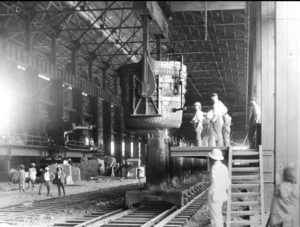
The Tata story combines industrial development, entrepreneurship, acquisitions, institution-building and international expansion.
The following chronology highlights major milestones. It is a historical overview, not a complete record of every Tata investment or corporate transaction.
4.1 The foundation: 1868–1917
| Year | Milestone | Significance |
|---|---|---|
| 1868 | Jamsetji Tata establishes a trading enterprise | Beginning of the Tata business history |
| 1874 | Empress Mills is established in Nagpur | Expansion into textile manufacturing |
| 1892 | The JN Tata Endowment is established | Support for higher education |
| 1903 | The Taj Mahal Hotel opens in Mumbai | Entry into hospitality |
| 1904 | Dorabji Tata succeeds Jamsetji Tata in leadership | Continuation of the founder’s industrial vision |
| 1907 | Tata Iron and Steel Company is established | Foundation of the steel business |
| 1909 | The Indian Institute of Science is established | Development of scientific research |
| 1910 | Early Tata hydroelectric power development advances | Expansion into electricity infrastructure |
| 1912 | Industrial development at Sakchi progresses | Growth of the settlement later known as Jamshedpur |
| 1917 | Tata Oil Mills Company is established | Expansion into consumer products |
These milestones show the group’s early movement from trading into manufacturing, infrastructure and institution-building.
Steel required large industrial facilities. Electricity required substantial investment in generation and distribution. Hospitality required long-term assets and service operations.
Alongside commercial development, Tata-related philanthropic and educational initiatives supported scientific research and social development.
4.2 Industrial expansion: 1918–1968
| Year | Milestone | Significance |
|---|---|---|
| 1919 | Jamshedpur is named in honour of Jamsetji Tata | Recognition of the founder’s industrial legacy |
| 1932 | J. R. D. Tata pilots an inaugural Tata Airlines flight | Beginning of the Tata aviation story |
| 1939 | Tata Chemicals is incorporated | Entry into industrial chemicals |
| 1945 | Tata Engineering and Locomotive Company is established | Foundation of the engineering and automotive business later known as Tata Motors |
| 1945 | Tata Institute of Fundamental Research is established | Investment in scientific research |
| 1952 | Lakmé is launched | Entry into cosmetics |
| 1954 | Voltas is incorporated | Expansion into engineering and air-conditioning |
| 1954 | Commercial-vehicle manufacturing develops through TELCO’s collaboration with Daimler-Benz | Development of the automotive business |
| 1962 | Tata’s tea business expands through Tata Finlay | Growth in beverages |
| 1962 | Tata Exports is established | International trading expansion |
| 1968 | Tata Consultancy Services is established | Entry into IT services and consulting |
The period helped establish businesses that later became major parts of the wider Tata ecosystem.
A lesson from brand history
Lakmé illustrates why historical association and present ownership must be distinguished. The brand was launched under Tata ownership and later sold to Hindustan Lever in 1996, following the 1994 agreement. It should not be presented as a currently Tata-owned brand.
Similarly, Tata Airlines’ historical role does not mean that the airline remained continuously under Tata ownership throughout its later history.
4.3 Diversification and global acquisitions: 1969–2017
| Year | Milestone | Significance |
|---|---|---|
| 1983 | Tata Salt is launched | Expansion into branded consumer food products |
| 1984 | Titan is established with Tamil Nadu Industrial Development Corporation | Entry into watches and lifestyle products |
| 1991 | Ratan Tata succeeds J. R. D. Tata as chairman | New leadership phase |
| 1991 | Tata Motors enters the passenger-car market | Diversification beyond commercial vehicles |
| 1994 | Tanishq is launched | Expansion into organised jewellery retail |
| 1998 | Tata Indica is launched | Major step in passenger-car development |
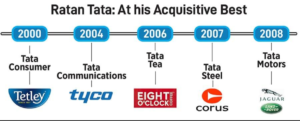
| 2000 | Tata Tea acquires Tetley | Major international acquisition in tea |
| 2001 | Tata’s insurance businesses expand through partnerships | Development of financial services |
| 2002 | Tata acquires a controlling stake in VSNL | Development of the business that became Tata Communications |
| 2004 | TCS completes its initial public offering | IT services becomes a separately listed company |
| 2004 | Tata Motors acquires Daewoo’s commercial-vehicle business | International automotive expansion |
| 2006 | Tata Sky is launched | Entry into direct-to-home television |
| 2006 | Croma is launched by Infiniti Retail | Entry into organised electronics retail |
| 2007 | Tata Steel acquires Corus | Major international steel acquisition |
| 2008 | Tata Motors acquires Jaguar Land Rover | Entry into the premium global automotive market |
| 2012 | Tata’s consumer business enters a joint venture with Starbucks | Expansion into café retail |
Acquisitions must be evaluated by the acquiring legal entity, the transaction date, the stake acquired and subsequent restructuring. A historical transaction does not prove that the acquired business retains the same legal structure today.
4.4 Digital transformation and new industries: 2018–2026
| Period | Development | Significance |
|---|---|---|
| 2020 | Tata companies and Tata Trusts support India’s COVID-19 response | Corporate and philanthropic activity during a public-health emergency |
| 2021 | Tata Digital acquires majority stakes in BigBasket and 1mg | Expansion into digital consumer and healthcare commerce |
| 2022 | Air India returns to Tata control | Re-entry into aviation |
| 2022 onward | Tata businesses advance electric mobility and digital initiatives | Diversification into technology-intensive markets |
| 2023 onward | Electronics manufacturing initiatives progress | Development of domestic electronics supply chains |
| 2024–2026 | New manufacturing and digital projects continue | Requires project-specific verification of investment and operational status |
Proposed Tata Sons reorganisation in September 2026
Tata Trusts announced a proposed strategic reorganisation of Tata Sons in September 2026 involving Tata Electronics Systems Solutions Private Limited and Tata Consulting Engineers.
A proposal must not be described as a completed merger unless the relevant approvals and implementation are confirmed through official filings.
The latest status should be checked here:
This example demonstrates why corporate structures must be researched as of a specific reporting date.
4.5 Major Tata leaders
| Leader | Role | Historical significance |
|---|---|---|
| Jamsetji Nusserwanji Tata | Founder | Established the foundation of the Tata enterprise |
| Sir Dorabji Tata | Successor to the founder | Helped develop steel and power ambitions |
| J. R. D. Tata | Chairman from 1938 to 1991 | Led decades of industrial and business expansion |
| Ratan Naval Tata | Chairman from 1991 to 2012 | Oversaw restructuring and major international acquisitions |
| N. Chandrasekaran | Chairman of Tata Sons from 2017 | Led a period of digital, consumer and industrial expansion |
The roles and dates above are historical summaries. Current leadership, board membership and proposed reappointments should be checked against the latest company disclosures.
5. Major Tata Group Companies
The official Tata Group directory is the primary reference for its major companies. The published count of 31 should not be confused with the total number of subsidiaries, associates, joint ventures and other entities across the wider ecosystem.
Official directory: https://www.tata.com/investors/companies
The following sector-wise register identifies principal businesses and explains their activities. It is an overview, not a substitute for a verified legal-entity schedule.
5.1 Technology and digital services
| Company | Main activities | Principal business model | Website |
|---|---|---|---|
| Tata Consultancy Services (TCS) | IT services, consulting, cloud, enterprise technology and digital transformation | Contracts for technology services and consulting | https://www.tcs.com/ |
| Tata Elxsi | Design, engineering and technology services | Project-based and long-term engineering contracts | https://www.tataelxsi.com/ |
| Tata Technologies | Product engineering and digital manufacturing services | Engineering and technology contracts | https://www.tatatechnologies.com/ |
| Tata Digital | Digital consumer platforms and investments | Platform operations and investments through relevant entities | https://www.tatadigital.com/ |
The legal parent, listed status and subsidiary structure must be confirmed from each company’s latest filings.
5.2 Automobiles and mobility
| Company | Main activities | Principal brands or businesses | Website |
|---|---|---|---|
| Tata Motors | Passenger and commercial vehicles, subject to current corporate structure | Tata-branded vehicles and related businesses | https://www.tatamotors.com/ |
| Jaguar Land Rover | Premium automotive operations | Jaguar, Range Rover, Defender and Discovery | https://www.jlr.com/ |
| Tata AutoComp Systems | Automotive components and systems | Components, systems and joint-venture businesses | https://www.tataautocomp.com/ |
Corporate restructuring note: Tata Motors’ demerger and subsequent corporate structure must be evaluated using the relevant effective dates and exchange disclosures. Historical company names should not be used as a substitute for the current legal entity.
Jaguar Land Rover is part of the wider automotive ecosystem associated with Tata Motors. Its brands should not be treated as separate direct Tata Sons subsidiaries without supporting legal evidence.
5.3 Steel and materials
| Company | Main activities | Business model | Website |
|---|---|---|---|
| Tata Steel | Steelmaking, processing and related materials | Industrial sales and value-added steel products | https://www.tatasteel.com/ |
| Tata International | International trading and business activities | Trading, distribution and related operations | https://www.tatainternational.com/ |
Tata Steel’s international operations and subsidiary structure have evolved through acquisitions, reorganisations and disposals. The latest annual report should be used to identify the current entities.
5.4 Chemicals and industrial products
| Company | Main activities | Website |
|---|---|---|
| Tata Chemicals | Chemicals, materials and consumer salt businesses | https://www.tatachemicals.com/ |
| Voltas | Air-conditioning, cooling and engineering solutions | https://www.voltas.com/ |
Company-level financials and the legal ownership of individual products should be obtained from the respective annual reports and official product directories.
5.5 Consumer products and food
| Company | Main activities | Examples of brands or products | Website |
|---|---|---|---|
| Tata Consumer Products | Packaged foods, beverages and related consumer products | Tata Tea, Tetley, Tata Salt, Tata Sampann and other products | https://www.tataconsumer.com/ |
The company has a broader portfolio than the examples shown. The precise parent company of each brand and its geographic availability should be verified through official brand pages and corporate disclosures.
5.6 Jewellery, watches and eyewear
| Company | Main activities | Examples of brands or formats | Website |
|---|---|---|---|
| Titan Company | Jewellery, watches, eyewear and lifestyle products | Tanishq, Mia, Zoya, Fastrack, Titan Eye+ and Helios | https://www.titancompany.in/ |
The brand portfolio spans different customer segments and price points. Individual businesses may have distinct operating arrangements, product lines and geographic reach.
5.7 Retail and electronics
| Company | Main activities | Examples of formats or businesses | Website |
|---|---|---|---|
| Trent | Organised retail | Westside, Zudio and Star | https://trentlimited.com/ |
| Infiniti Retail | Consumer-electronics retail | Croma | https://www.croma.com/ |
| BigBasket | Online grocery commerce | BigBasket and associated grocery services | https://www.bigbasket.com/ |
Retail brands, digital storefronts and corporate entities are different categories. The ownership of a platform or store format should be established from the current legal operator’s filings.
5.8 Power and infrastructure
| Company | Main activities | Website |
|---|---|---|
| Tata Power | Electricity generation, distribution, renewables and energy solutions | https://www.tatapower.com/ |
| Tata Projects | Engineering, procurement and construction | https://www.tataprojects.com/ |
Tata Power’s activities include conventional power, renewable energy and customer-facing energy solutions. Project status varies and should be checked individually.
5.9 Financial services
| Company | Main activities | Website |
|---|---|---|
| Tata Capital | Financial services and lending, subject to its current regulated structure | https://www.tatacapital.com/ |
| Tata AIA Life Insurance | Life insurance through a joint-venture structure | https://www.tataaia.com/ |
| Tata AIG General Insurance | General insurance through a joint-venture structure | https://www.tataaig.com/ |
Financial services involve regulatory requirements that differ from those governing ordinary manufacturing or retail businesses. Ownership percentages and licence status should be checked against current regulatory disclosures.
5.10 Hotels and hospitality
| Company | Main activities | Examples of hotel brands | Website |
|---|---|---|---|
| Indian Hotels Company Limited (IHCL) | Hotels, hospitality and related services | Taj, SeleQtions, Vivanta, Ginger and amã Stays & Trails | https://www.ihcltata.com/ |
A hotel brand can cover multiple properties operated under different management, ownership or franchise arrangements. Brand association alone does not establish that the parent company owns every hotel building.
5.11 Aviation
| Company | Main activities | Website |
|---|---|---|
| Air India | Full-service airline operations | https://www.airindia.com/ |
| Air India Express | Airline operations focused on its market segment | https://www.airindiaexpress.com/ |
The airline businesses have undergone major restructuring. The current group structure, fleet, routes and operating performance should be checked against the latest airline disclosures.
5.12 Telecommunications and media
| Company | Main activities | Website |
|---|---|---|
| Tata Communications | Global connectivity and digital infrastructure | https://www.tatacommunications.com/ |
| Tata Play | Television distribution and related services | https://www.tataplay.com/ |
Telecommunications, connectivity, television distribution and digital services have different regulatory and commercial models. The relevant company must be identified before attributing a brand or revenue figure.
5.13 Aerospace and defence
| Company | Main activities | Website |
|---|---|---|
| Tata Advanced Systems | Aerospace, defence and advanced manufacturing | https://www.tataadvancedsystems.com/ |
The sector includes partnerships and manufacturing arrangements with other businesses and government customers. A partnership or production agreement should not automatically be interpreted as ownership of a partner’s entire business.
5.14 Additional entities and corporate relationships
The preceding tables are not a verified reproduction of every company in the official directory. They identify principal businesses for the sector overview.
Before publishing a claim that the list contains exactly 31 current major companies, compare the latest official directory with the latest Tata Sons annual report and each relevant corporate filing.
Official references:
6. Tata Brands and Products
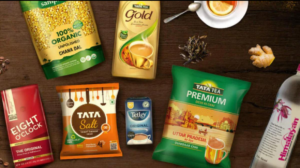
A brand is not necessarily a company. A single company can own several brands, while one brand may be used across different products, markets or operating arrangements.
The following register provides a starting point for researching important brands in the Tata ecosystem.
6.1 Consumer goods and food brands
| Brand | Category | Associated business | Important distinction |
|---|---|---|---|
| Tata Tea | Tea | Tata Consumer Products | Consumer product brand |
| Tetley | Tea and beverages | Tata Consumer Products’ wider business ecosystem | Acquired international brand; verify specific operating entity |
| Tata Salt | Salt | Tata Consumer Products | Consumer product brand |
| Tata Sampann | Packaged foods | Tata Consumer Products | Consumer product brand |
| Tata Soulfull | Food products | Tata Consumer Products’ wider business ecosystem | Brand and product portfolio |
| Eight O’Clock Coffee | Coffee | Tata Consumer Products’ international business ecosystem | International coffee brand; verify current legal ownership and operator |
Official reference: https://www.tataconsumer.com/
6.2 Jewellery, watches and eyewear brands
| Brand | Category | Associated business |
|---|---|---|
| Tanishq | Jewellery | Titan Company |
| Mia | Jewellery | Titan Company |
| Zoya | Fine jewellery | Titan Company |
| CaratLane | Jewellery retail | Titan Company ecosystem; verify current legal structure |
| Fastrack | Watches and lifestyle accessories | Titan Company |
| Titan | Watches and lifestyle products | Titan Company |
| Titan Eye+ | Eyewear retail | Titan Company |
| Helios | Watch retail | Titan Company |
Official reference: https://www.titancompany.in/
6.3 Retail brands and formats
| Brand or format | Category | Associated business |
|---|---|---|
| Westside | Fashion and lifestyle retail | Trent |
| Zudio | Value-focused fashion retail | Trent |
| Star | Food and grocery retail | Trent |
| Croma | Consumer-electronics retail | Infiniti Retail |
| BigBasket | Online grocery commerce | BigBasket’s operating entity within the Tata ecosystem |
| Tata Neu | Digital consumer platform | Tata Digital ecosystem |
Official references:
- https://trentlimited.com/
- https://www.croma.com/
- https://www.bigbasket.com/
- https://www.tatadigital.com/
6.4 Automotive brands
| Brand | Category | Associated business |
|---|---|---|
| Tata Motors | Automotive corporate and product identity | Relevant Tata automotive legal entities |
| Jaguar | Premium automobiles | Jaguar Land Rover |
| Range Rover | Premium SUVs | Jaguar Land Rover |
| Defender | SUVs | Jaguar Land Rover |
| Discovery | SUVs | Jaguar Land Rover |
The automotive brands have distinct histories and product strategies. They should not be described as separately incorporated Tata Sons subsidiaries merely because they appear in the same corporate ecosystem.
Official reference: https://www.jlr.com/
6.5 Hospitality brands
| Brand | Category | Associated business |
|---|---|---|
| Taj | Luxury hospitality | Indian Hotels Company |
| SeleQtions | Hospitality | Indian Hotels Company |
| Vivanta | Hospitality | Indian Hotels Company |
| Ginger | Hospitality | Indian Hotels Company |
| amã Stays & Trails | Holiday homes and hospitality | Indian Hotels Company |
Official reference: https://www.ihcltata.com/
6.6 Technology and service brands
| Name | Category | Associated business |
|---|---|---|
| TCS | IT services | Tata Consultancy Services |
| Tata Elxsi | Design and engineering services | Tata Elxsi |
| Tata Technologies | Engineering and digital services | Tata Technologies |
| Tata Communications | Connectivity and digital infrastructure | Tata Communications |
Official references:
- https://www.tcs.com/
- https://www.tataelxsi.com/
- https://www.tatatechnologies.com/
- https://www.tatacommunications.com/
6.7 Energy, finance and digital brands
| Name | Category | Associated business |
|---|---|---|
| Tata Power | Energy | Tata Power |
| Tata Capital | Financial services | Tata Capital |
| Tata Neu | Digital consumer platform | Tata Digital ecosystem |
| Tata Play | Television and digital entertainment services | Tata Play |
Official references:
- https://www.tatapower.com/
- https://www.tatacapital.com/
- https://www.tatadigital.com/
- https://www.tataplay.com/
Brand ownership warning
This is a representative brand register, not a complete verified master list of every Tata-related brand worldwide.
The precise legal owner, trademark owner, operator, licensee, country of operation and current status should be recorded separately for every entry.
Brands sold to other companies, discontinued products, historic names and joint-venture brands should not be presented as currently Tata-owned without evidence.
7. Subsidiaries, Associates and Joint Ventures
A complete corporate ecosystem investigation requires more than the names of major companies.
7.1 Subsidiaries
A subsidiary is a legal entity controlled by another company under the applicable legal and accounting framework.
The ownership may be direct or indirect. A parent company may hold a subsidiary directly, while a subsidiary may itself own other businesses.
For every subsidiary, the research record should contain:
- Exact legal name.
- Country of incorporation.
- Immediate parent company.
- Direct shareholding.
- Indirect shareholding where relevant.
- Business activity.
- Financial reporting period.
- Source document.
7.2 Associates
An associate is generally an investee over which an investor has significant influence but does not exercise control.
An associate is not automatically a subsidiary. Its revenue should not simply be added to the investor’s revenue as if both businesses were wholly owned and consolidated.
7.3 Joint ventures
Joint ventures involve joint control under the relevant legal agreements and accounting framework.
Examples of Tata-associated joint-venture businesses have included insurance and consumer-service ventures. The exact partners, ownership percentages and current legal arrangements must be checked against current disclosures.
7.4 Why the annual report matters
The latest Tata Sons annual report and its annexures are important sources for identifying the entities included in its corporate disclosures.
However, Tata Sons’ entity list does not necessarily constitute a complete register of every subsidiary and brand belonging to every company across the wider Tata ecosystem.
A company-by-company review is required.
Official document repository: https://www.tata.com/about-us/tata-sons/documents
Recommended corporate relationship table
| Field | Required information |
|---|---|
| Legal entity | Exact registered name |
| Immediate parent | Direct shareholder or parent |
| Relationship | Subsidiary, step-down subsidiary, associate or joint venture |
| Ownership | Verified percentage and relevant share class |
| Geography | Country of incorporation |
| Business | Principal activity |
| Reporting date | Date to which the information applies |
| Source | Annual report, regulatory filing or official announcement |
| Verification status | Verified, partially verified or unresolved |
This approach avoids incorrectly treating every company in the wider Tata ecosystem as a direct Tata Sons subsidiary.
8. Tata Trusts and Philanthropy

Tata Trusts has a long institutional history associated with philanthropy and public-interest initiatives.
Its work covers areas such as healthcare, education, livelihoods, nutrition, rural development, water, sanitation and social inclusion.
Official website: https://www.tatatrusts.org/
8.1 Ownership versus management
Ownership and management are different concepts.
Tata Trusts’ shareholding in Tata Sons is a shareholder relationship. Tata Sons has its own corporate governance structure. Operating companies have their own boards and executive management.
A shareholder’s rights depend on the applicable corporate law, shareholding structure, constitutional documents and other relevant arrangements.
The fact that Tata Trusts holds a significant stake in Tata Sons does not establish that the trusts directly manage the day-to-day operations of every Tata company.
8.2 Dividends and charitable grants
Dividends are distributions made by a company to its shareholders in accordance with applicable law and corporate decisions.
Charitable grants are funds provided by a trust or other philanthropic institution for eligible charitable purposes.
These are different financial flows.
It is incorrect to state that Tata Trusts receives 66% of Tata Group revenue simply because the trusts hold approximately 66% of Tata Sons’ equity.
Revenue belongs to the company that earns it. Any dividend distribution depends on the relevant company’s distributable profits, applicable law and corporate decisions.
8.3 Corporate social responsibility
Corporate social responsibility expenditure is distinct from philanthropic grants made by a charitable trust.
CSR obligations arise under applicable legal requirements and are reported by the relevant company. Trust grants arise under the legal and governance arrangements of the relevant trust.
These activities may support similar social objectives, but their sources of funding, reporting obligations and decision-making structures differ.
9. How Tata Businesses Make Money
The Tata ecosystem includes multiple business models. Understanding these models is more useful than assuming that all group companies earn money in the same way.
| Sector | Main revenue sources | Important business risks |
|---|---|---|
| IT services | Consulting, software services, maintenance and technology contracts | Client spending, competition and talent costs |
| Automobiles | Vehicle sales, components and related services | Demand cycles, input costs and product development |
| Steel | Steel products and industrial materials | Commodity prices, energy costs and global demand |
| Chemicals | Chemical products and industrial materials | Raw materials, regulation and demand cycles |
| Consumer goods | Packaged foods and beverages | Distribution costs, pricing and competition |
| Retail | Product sales through stores and online channels | Rent, inventory, margins and consumer demand |
| Jewellery | Jewellery sales and related products | Gold prices, inventory and consumer preferences |
| Hospitality | Room revenue, food and beverage, events and related services | Occupancy, travel demand and operating costs |
| Aviation | Passenger travel, cargo and ancillary services | Fuel, fleet costs, route demand and competition |
| Telecommunications | Connectivity, network and digital infrastructure services | Capital expenditure, pricing and technology change |
| Financial services | Interest income, fees and other regulated financial products | Credit losses, funding costs and regulation |
| Power and energy | Electricity sales, energy services and related activities | Fuel costs, tariffs and capital expenditure |
| Aerospace and defence | Manufacturing contracts, systems and engineering services | Contract execution, certification and procurement cycles |
These descriptions explain typical sector models. They do not replace the revenue recognition policies or segment reporting of individual companies.
9.1 IT services
IT services businesses generate revenue by providing technology expertise, consulting, software development, infrastructure management, cybersecurity, cloud services and other contracted work.
The financial performance depends on the mix of services, client spending, employee costs, utilisation, pricing and the geographic distribution of revenue.
9.2 Automobiles
Automotive companies generate revenue from vehicle sales, components, financing arrangements where applicable, parts and related services.
Profitability is influenced by manufacturing efficiency, product mix, research and development, warranty expenses, commodity prices and competitive conditions.
9.3 Steel and chemicals
Industrial businesses often operate with substantial fixed assets and exposure to commodity prices.
Their earnings may vary considerably between reporting periods because of raw-material costs, energy prices, global demand, capacity utilisation and currency movements.
9.4 Consumer products and retail
Consumer-product businesses sell branded goods through wholesale distribution, retail outlets and online channels.
Retailers earn revenue from merchandise sales. Their operating performance depends on inventory turnover, gross margins, store productivity, rent, distribution and customer demand.
9.5 Hospitality and aviation
Hotels earn money through accommodation, food and beverage, events and other guest services.
Airlines primarily earn money from passenger travel, with additional revenue from cargo and ancillary services where applicable.
Both sectors are affected by demand fluctuations and substantial operating costs, although their cost structures differ.
10. Financial Performance and Market Capitalisation
Financial analysis must distinguish between company-level results and group-level figures.
10.1 Key financial terms
| Term | Meaning |
|---|---|
| Revenue | Income from a company’s business activities |
| EBITDA | Earnings before interest, tax, depreciation and amortisation |
| Operating profit | Profit from operations under the relevant reporting definition |
| Net profit | Profit after applicable expenses and taxes |
| Assets | Resources recognised on the company’s balance sheet |
| Debt | Borrowings and other obligations classified as debt |
| Market capitalisation | Market value of a listed company’s equity at a specified time |
| Standalone accounts | Financial statements of the individual legal entity |
| Consolidated accounts | Financial statements combining the parent and relevant controlled entities |
Market capitalisation is not revenue. A company’s share price may change daily, whereas its annual revenue is reported for a specified financial period.
10.2 Why standalone and consolidated accounts differ
Tata Sons’ standalone accounts report the company’s own financial position and results.
Its consolidated accounts, where applicable, include the results of entities consolidated under the relevant accounting rules.
The wider Tata Group’s aggregate business performance is not automatically equivalent to either Tata Sons’ standalone or consolidated revenue.
Adding the revenues of a parent and its subsidiaries without eliminating internal transactions can result in double counting.
10.3 Financial reporting checklist
Before including any financial figure, verify:
- The exact legal entity.
- The financial year or reporting period.
- The currency and units.
- Whether the figure is standalone or consolidated.
- Whether it is audited, provisional or an interim result.
- The official source and publication date.
- Whether the same transaction is already included in another reported figure.
Financial data table template
| Company | Financial year | Revenue | Operating profit or EBITDA | Net profit | Debt | Basis |
|---|---|---|---|---|---|---|
| Tata Consultancy Services | Verify latest annual report | Not inserted without source verification | Not inserted without source verification | Not inserted without source verification | Not inserted without source verification | Consolidated or standalone must be specified |
| Tata Motors | Verify relevant post-restructuring reporting entity | Not inserted without source verification | Not inserted without source verification | Not inserted without source verification | Not inserted without source verification | Confirm legal entity and reporting basis |
| Tata Steel | Verify latest annual report | Not inserted without source verification | Not inserted without source verification | Not inserted without source verification | Not inserted without source verification | Consolidated or standalone must be specified |
| Tata Power | Verify latest annual report | Not inserted without source verification | Not inserted without source verification | Not inserted without source verification | Not inserted without source verification | Consolidated or standalone must be specified |
| Titan Company | Verify latest annual report | Not inserted without source verification | Not inserted without source verification | Not inserted without source verification | Not inserted without source verification | Consolidated or standalone must be specified |
These cells intentionally do not contain guessed financial figures. Populate them from each company’s latest officially published financial statements before presenting the table as a verified financial comparison.
Official references:
- https://www.tata.com/investors
- https://www.bseindia.com/
- https://www.nseindia.com/
- https://www.sebi.gov.in/
11. Major Acquisitions and International Expansion
Acquisitions have played an important role in the Tata Group’s international development.
The acquiring company, transaction date and present ownership should always be identified separately.
11.1 Tetley
Tata Tea acquired Tetley in 2000. The transaction was a major international expansion in the tea business and helped develop the group’s international consumer-products presence.
Tetley should be researched through the current consumer-products corporate structure when determining its present legal owner and operator.
Official starting point: https://www.tataconsumer.com/
11.2 Corus
Tata Steel acquired Corus in 2007, expanding its international steel operations.
The transaction increased the scale and geographic reach of the business but also exposed it to the financial and operating conditions of international steel markets.
The present corporate structure and subsequent disposals must be checked against Tata Steel’s latest annual reports.
Official website: https://www.tatasteel.com/
11.3 Jaguar Land Rover
Tata Motors acquired Jaguar Land Rover in 2008.
The acquisition brought internationally recognised automotive brands into the Tata automotive ecosystem and expanded the company’s presence in premium vehicles.
The legal entity operating the automotive business and its brands should be distinguished from Tata Motors’ own corporate identity.
Official website: https://www.jlr.com/
11.4 Other international transactions
The wider Tata corporate history includes other acquisitions, investments and partnerships involving automobiles, consumer products, technology and industrial businesses.
A complete transaction register should record the acquiring legal entity, date, consideration where officially disclosed, percentage acquired, transaction rationale, subsequent ownership changes and current status.
Historical acquisition values should not be presented without checking the original announcement or relevant annual report.
12. Tata Digital, Tata Neu and the Consumer Ecosystem
The Tata consumer ecosystem includes digital platforms, grocery commerce, electronics retail, fashion retail, jewellery and other consumer-facing businesses.
However, the existence of several Tata-associated platforms does not establish that they all share the same customer database, technology systems or operating company.
12.1 Tata Digital
Tata Digital is associated with the group’s digital consumer initiatives and investments.
Its corporate structure, subsidiaries and investment relationships should be verified through current disclosures.
Official website: https://www.tatadigital.com/
12.2 Tata Neu
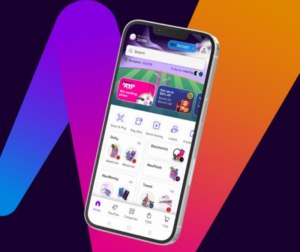
Tata Neu is a consumer-facing digital platform intended to connect users with participating Tata-related products and services.
The precise participating businesses, rewards arrangements, payment features and current terms should be checked against the platform’s official information.
The platform should not be described as the legal owner of every business available through it.
12.3 BigBasket
BigBasket operates in online grocery commerce.
Its business model includes digital ordering, sourcing, fulfilment and delivery. The exact operating entities, services and ownership arrangements should be verified through company disclosures.
Official website: https://www.bigbasket.com/
12.4 Croma
Croma operates in consumer-electronics retail.
Its business model includes the sale of electronic products through retail and digital channels.
Official website: https://www.croma.com/
12.5 Omnichannel retail
Omnichannel retail combines physical stores, online shopping and related customer-service channels.
For a business to deliver a genuinely integrated experience, its systems, inventory, customer support, fulfilment processes and loyalty arrangements must work together.
The presence of multiple brands within one business group does not prove complete operational integration. Such claims require evidence from company disclosures and actual platform terms.
13. Semiconductors, Electronics, EVs and Emerging Businesses
The Tata ecosystem has pursued opportunities in electronics manufacturing, electric mobility, renewable energy, advanced engineering and other technology-intensive areas.
These businesses should be analysed according to their actual stage of development.
13.1 Semiconductors
Semiconductor manufacturing involves substantial capital investment, specialised equipment, technical expertise and supply-chain coordination.
A semiconductor project can pass through several stages:
- Announcement and investment approval.
- Land acquisition and regulatory approvals.
- Construction and equipment installation.
- Pilot production and qualification.
- Commercial production.
- Capacity expansion and customer diversification.
These stages are not interchangeable.
A project announced for a particular location should not be described as commercially operational without an official disclosure confirming that status.
13.2 Electronics manufacturing
Electronics manufacturing can include component production, assembly, testing, precision engineering and supply-chain services.
The commercial model varies by facility and customer contract. The presence of a manufacturing project does not automatically establish the production volume, customer mix or profitability of the business.
13.3 Electric vehicles
Electric mobility includes vehicle manufacturing, batteries, charging infrastructure, software, components and related services.
The business opportunities differ across passenger vehicles, commercial vehicles, two-wheelers, fleet applications and charging networks.
Claims about production, sales or market share should specify the relevant vehicle category and reporting period.
13.4 Renewable energy
Renewable energy businesses may develop, own or operate solar, wind and other energy assets, depending on the relevant company and project.
An announced capacity target is not the same as commissioned capacity. A reliable analysis must distinguish proposed, under-construction and operational projects.
13.5 AI and data centres
Artificial intelligence and data-centre opportunities can involve computing infrastructure, software, cloud services, engineering, data management and enterprise consulting.
A company operating in technology services should not automatically be described as owning large-scale AI infrastructure. Such claims require evidence of the actual assets, services and commercial operations.
14. Leadership and Corporate Governance
The Tata ecosystem contains several layers of corporate governance.
14.1 Tata Sons board

Tata Sons has its own board of directors and corporate governance responsibilities.
The board’s role differs from that of the management team running a particular operating company.
14.2 Operating-company boards
Individual Tata companies have their own boards and executive management teams.
Listed companies are subject to relevant securities laws, exchange disclosure requirements and corporate governance regulations.
Privately held companies have different disclosure obligations, although they remain subject to applicable company law and other regulations.
14.3 Shareholder rights
Shareholders’ rights depend on the company’s legal structure, share class, constitutional documents, applicable legislation and relevant agreements.
A shareholder’s economic interest does not automatically establish direct authority over every operational decision.
14.4 Regulatory oversight
Different businesses operate under different regulatory frameworks.
Examples include:
- Securities and stock-exchange regulation for listed companies.
- Banking and financial-services regulation for relevant financial businesses.
- Insurance regulation for insurers.
- Aviation regulation for airlines.
- Environmental and industrial requirements for manufacturing facilities.
- Competition law for relevant commercial transactions.
The applicable regulator depends on the business and transaction involved.
14.5 Why the chairman does not personally manage every company
The Tata Sons chairman holds a group-level leadership role, but individual companies have their own directors and management teams.
Corporate governance responsibilities must be interpreted through the relevant company’s board structure, shareholder rights and legal obligations.
It is inaccurate to assume that one chairman personally manages every Tata company or makes every operating decision.
15. Competition and Market Position
Tata businesses operate in different markets and face different competitors. The Tata Group should not be described as the market leader in every industry merely because it is diversified.
Examples of relevant competitive categories include:
| Tata business | Competitive market | Appropriate comparison |
|---|---|---|
| TCS | IT services and consulting | Comparable IT services companies |
| Tata Motors | Automotive manufacturing | Vehicle categories and geographic markets |
| Tata Steel | Steel production | Comparable steel producers |
| Tata Consumer Products | Packaged foods and beverages | Relevant consumer-product categories |
| Titan Company | Jewellery, watches and eyewear | Specific product and retail segments |
| Trent | Organised retail | Comparable retail formats |
| Indian Hotels Company | Hospitality | Comparable hotel categories |
| Tata Power | Electricity and energy solutions | Comparable generation, distribution or renewable-energy businesses |
| Tata Communications | Connectivity and digital infrastructure | Comparable enterprise connectivity providers |
A fair comparison requires the same reporting period, geography, business segment and measurement method.
Revenue alone may not reveal profitability, customer retention, productivity or financial risk. Market share must also be calculated using a clearly defined market.
Any claim of market leadership should be supported by a credible and dated independent source.
16. Common Misunderstandings About Tata
Is Tata Group one legal company?
No. It is a broader business group comprising separately incorporated companies and other entities.
Is Tata Sons the same as Tata Group?
No. Tata Sons is a legal company that serves as the principal investment holding company and promoter of Tata companies. Tata Group refers to the wider business ecosystem.
Does Tata Trusts own 66% of every Tata company?
No. The approximately 66% figure refers to Tata Trusts’ collective shareholding in Tata Sons, not a direct 66% stake in every Tata-associated company.
Is Tata Sons the direct parent of every Tata business?
No. Some businesses are owned through intermediate companies, while others may involve associates, joint ventures, minority investments or commercial partnerships.
Are all Tata companies listed on the stock exchange?
No. Some Tata companies are listed, while others are privately held or operate as subsidiaries of other entities.
Are all brands containing the word Tata owned by Tata Sons?
No. The name alone does not prove ownership. The legal owner and operator must be verified.
Does a 66% stake mean Tata Trusts receives 66% of revenue?
No. Shareholding and revenue are different concepts. Dividends depend on the relevant company’s distributable profits and corporate decisions.
Is a brand the same as a company?
No. A company is a legal entity. A brand is a commercial identity that may be owned, operated or licensed by one or more legal entities under different arrangements.
What is the difference between a subsidiary, associate and joint venture?
A subsidiary is controlled by a parent. An associate generally involves significant influence without control. A joint venture involves joint control under the applicable arrangement.
Does an announced project mean a factory is operational?
No. Announcement, approval, construction, pilot production and commercial production are separate stages.
17. Company and Brand Coverage Register

An evidence-based corporate investigation should document what was reviewed and what remains unresolved.
The following matrix describes the principal research sources required for a full company-by-company review.
| Research area | Primary source | Required verification |
|---|---|---|
| Major Tata companies | https://www.tata.com/investors/companies | Current directory and classification |
| Tata Sons ownership and governance | https://www.tata.com/business/tata-sons | Current shareholding and governance disclosures |
| Tata Sons annual reports | https://www.tata.com/about-us/tata-sons/documents | Subsidiaries, financial statements and related entities |
| Tata Trusts | https://www.tatatrusts.org/ | Trust structure, charitable activities and official announcements |
| Consumer brands | Relevant company websites | Brand ownership and current status |
| Listed-company financials | BSE and NSE filings | Audited figures, corporate actions and reporting periods |
| Corporate regulation | https://www.mca.gov.in/ | Corporate identity and statutory filings |
| Securities regulation | https://www.sebi.gov.in/ | Applicable securities disclosures |
| Historical transactions | Company announcements and annual reports | Acquiring entity, transaction date and subsequent changes |
17.1 Completeness limitations
A public-source investigation cannot guarantee that every historical, local, discontinued, confidential or unregistered brand will be identified.
The wider Tata ecosystem includes entities that may not appear as direct subsidiaries of Tata Sons. A complete legal-entity register therefore requires reviewing the relevant annual reports of major operating companies and their subsidiaries.
Similarly, the brand register should be updated when companies acquire, dispose of, license, rename or discontinue brands.
This article provides a structured overview and representative brand inventory. It should not be interpreted as proof that every company, subsidiary, associate, joint venture or brand has been individually verified as of 24 October 2026.
18. Frequently Asked Questions

1. When was the Tata Group founded?
The Tata business history began in 1868, when Jamsetji Nusserwanji Tata established a trading enterprise.
2. What is Tata Sons?
Tata Sons Private Limited is the principal investment holding company and promoter of Tata companies.
3. What is the relationship between Tata Sons and Tata Trusts?
Tata Trusts collectively hold approximately 66% of Tata Sons’ equity share capital. The trusts and Tata Sons have different legal identities and purposes.
4. How many major companies are in the Tata Group?
The official Tata Group directory has described the group as comprising 31 companies. The current directory should be checked for changes in classification or corporate structure.
5. Is TCS part of the Tata Group?
Yes. Tata Consultancy Services is a major technology services company associated with the Tata Group.
6. Does Tata Sons own Jaguar Land Rover directly?
Jaguar Land Rover is part of the automotive ecosystem associated with Tata Motors. The precise direct and indirect ownership structure should be confirmed through current corporate disclosures.
7. Is Tanishq a separate company?
Tanishq is a jewellery brand associated with Titan Company. The brand should be distinguished from its legal operating company.
8. Does Tata Trusts receive 66% of Tata Group revenue?
No. The approximately 66% figure refers to its shareholding in Tata Sons. Revenue and dividends are different financial concepts.
9. What are the major Tata businesses?
Major businesses include IT services, automobiles, steel, chemicals, consumer products, jewellery, retail, energy, hospitality, aviation, telecommunications and financial services.
10. How does TCS earn money?
TCS primarily earns revenue through IT services, consulting, technology implementation, software-related services and long-term client contracts.
11. How does Tata Steel earn money?
Tata Steel generates revenue through steel manufacturing, processing and sales of related products.
12. What is Tata Neu?
Tata Neu is a consumer-facing digital platform associated with Tata Digital’s wider ecosystem.
13. Does the Tata Group operate internationally?
Yes. The group has international operations through businesses, subsidiaries, acquisitions, joint ventures and brands in multiple markets.
14. Are all Tata brands owned by the same company?
No. Different legal entities may own or operate brands, and some arrangements involve licensing, joint ownership or distribution.
15. Where can I find official Tata annual reports?
Start with the Tata Sons documents page and the investor-relations section of the relevant operating company.
Official link: https://www.tata.com/about-us/tata-sons/documents
19. The Complete Tata Sons And Tata Group Business Empire Conclusion
The Tata Group’s history illustrates how a trading enterprise established in 1868 developed into a diversified business ecosystem spanning industrial manufacturing, technology, consumer products, mobility, energy, finance, retail and hospitality.
Understanding the group requires more than memorising company and brand names. The most important questions are who legally owns each entity, which company operates a brand, whether a business is a subsidiary or joint venture, and which financial statements accurately represent its performance.
Tata Sons, Tata Trusts and the wider Tata Group perform different roles. Their relationships should be explained through official corporate records rather than assumptions based on the Tata name.
The same standard applies to acquisitions, international brands, new manufacturing projects and financial comparisons. A reliable corporate profile distinguishes verified facts from interpretation and identifies the reporting date for every material claim.
For readers researching India’s business landscape, the Tata ecosystem provides a useful case study in industrial development, diversification, international acquisitions, corporate governance and the long-term evolution of business groups.
20. Sources and Further Reading
- Tata Group — Official Website
https://www.tata.com/ - Tata Group — Companies Directory
https://www.tata.com/investors/companies - Tata Sons — Official Profile
https://www.tata.com/business/tata-sons - Tata Sons — Annual Reports and Documents
https://www.tata.com/about-us/tata-sons/documents - Tata Trusts — Official Website
https://www.tatatrusts.org/ - Tata Group — Historical Timeline
https://www.tata.com/about-us/tata-group-our-heritage/Our-Timeline - Tata Group — Brands Showcase
https://www.tata.com/brands-showcase - Tata Consultancy Services
https://www.tcs.com/ - Tata Motors
https://www.tatamotors.com/ - Tata Steel
https://www.tatasteel.com/ - Tata Chemicals
https://www.tatachemicals.com/ - Tata Consumer Products
https://www.tataconsumer.com/ - Titan Company
https://www.titancompany.in/ - Trent
https://trentlimited.com/ - Tata Power
https://www.tatapower.com/ - Indian Hotels Company
https://www.ihcltata.com/ - Tata Communications
https://www.tatacommunications.com/ - Tata Capital
https://www.tatacapital.com/ - Tata Digital
https://www.tatadigital.com/ - Tata Advanced Systems
https://www.tataadvancedsystems.com/ - BSE India
https://www.bseindia.com/ - National Stock Exchange of India
https://www.nseindia.com/ - Ministry of Corporate Affairs
https://www.mca.gov.in/ - Securities and Exchange Board of India
https://www.sebi.gov.in/
Suggested Article links for 2 NICE LIFE
- Zomato marketing strategy case study: https://2nicelife.com/zomato-marketing-strategy/
- ChatGPT advertising guide: https://2nicelife.com/chatgpt-ads-complete-guide/
- ISKCON marketing strategy case study: https://2nicelife.com/iskcon-marketing-strategy/
- Global brand launch guide: https://2nicelife.com/launching-a-global-brand-in-india/
22. Digital Growth Support by 2 NICE LIFE

Studying successful companies can help businesses understand brand positioning, customer acquisition, digital transformation and long-term growth.
If your business needs support with digital marketing strategy, SEO, content marketing, paid advertising, lead generation, website development or digital growth planning, explore 2 NICE LIFE.
Visit: https://2nicelife.com/
2 NICE LIFE — Your Growth Partner.