Digital advertising is entering a new phase. For years, businesses have relied on search engines, social media platforms, video advertising, and display networks to reach potential customers. Now, AI-powered conversational platforms are creating another environment where people research products, compare alternatives, explore services, and make purchasing decisions.
This development has introduced a new opportunity for marketers: ChatGPT Ads.
OpenAI has developed an advertising platform that allows eligible businesses to promote products and services within the ChatGPT experience. Its advertising system is designed to display relevant, clearly labelled advertisements separately from ChatGPT’s organic responses.
As of October 2026, ChatGPT Ads is in beta, with self-service campaign management available in supported markets, including India. However, advertising eligibility, permitted business categories, and access to particular features depend on OpenAI’s current requirements.
For business owners, startups, marketing professionals, and entrepreneurs, understanding this platform is becoming increasingly important. It offers an additional channel to investigate, but its suitability must be assessed through actual campaign performance rather than assumptions about AI’s popularity.
In this guide, we explain what ChatGPT Ads are, how they work, how much they cost, how businesses can get started, and how to develop a practical advertising strategy.
What Are ChatGPT Ads?
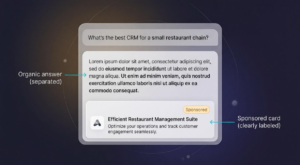
ChatGPT Ads are paid advertisements displayed within the ChatGPT experience. They give eligible advertisers an opportunity to present their products or services to users while those users explore questions, compare options, and research possible solutions.
For example, imagine someone asking ChatGPT for ideas to improve a home office. An advertisement for office furniture could appear below the response, provided the advertisement is eligible and considered relevant to the conversation.
Similarly, someone researching educational software might encounter an advertisement for a relevant digital product.
These are illustrative examples, not claims about guaranteed ad placements.
OpenAI’s official documentation describes an advertising experience in which ads can use contextual signals, including the current conversation, the advertisement’s content, its landing page, and certain additional signals when ad personalization is enabled.
Businesses can explore the official platform through OpenAI Ads.
How Are ChatGPT Ads Different From Organic Responses?
Understanding the distinction between advertising and organic responses is essential.
Organic ChatGPT responses are generated by ChatGPT in response to a user’s request. They are not automatically advertisements simply because they mention a company, product, or service.
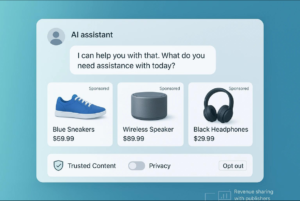
ChatGPT Ads are paid promotional placements identified as advertisements and displayed separately from the assistant’s response.
An organic response might explain how to choose a digital marketing agency. A separate advertisement might promote an agency’s services.
The appearance of a company in an organic answer does not, by itself, establish that the company paid for advertising.
OpenAI states that advertisements are clearly labelled and kept separate from ChatGPT’s answers. This distinction is important for maintaining transparency and user trust.
How ChatGPT Advertising Differs From Traditional Advertising
Traditional search advertising often connects advertisements with search queries, keywords, and auction-based bidding. Social media advertising can use campaign objectives, audience settings, creative assets, and platform signals.
ChatGPT Ads introduce another environment: a conversational interface in which people may explain their requirements in considerable detail.
Instead of searching only for a phrase such as “office chair,” someone might describe their budget, available space, preferred design, and intended use.
That conversational context creates opportunities for more relevant advertising. However, relevance does not guarantee a click, purchase, or conversion.
The platform should therefore be evaluated as a distinct advertising channel rather than assumed to be a replacement for Google Ads or Meta Ads.
How Do ChatGPT Ads Work?
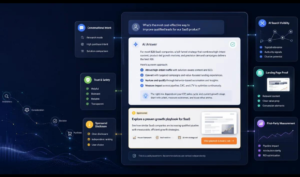
OpenAI’s advertising documentation explains several important parts of the current system.
1. Advertisements Appear Below ChatGPT Responses
The documented advertising format places advertisements below ChatGPT responses.
An ad can include:
- Advertiser name and logo.
- An advertising headline.
- Descriptive copy.
- A landing page link.
- An image asset.
The advertisement is visually distinguished from the assistant’s response.
The exact advertising experience may evolve as OpenAI develops additional formats and platform capabilities.
2. Ad Delivery Uses Relevance Signals
ChatGPT Ads do not rely exclusively on traditional keyword matching.
OpenAI says its advertising system considers multiple signals, including:
- The context and intent of the current conversation.
- The advertisement’s headline and description.
- The destination landing page.
- Context hints supplied by the advertiser.
- Certain signals from a user’s broader ChatGPT experience when ad personalization is enabled.
Advertisers can provide context hints describing conversations, topics, or keywords where their products may be relevant.
These hints help guide advertising relevance, but they are not exact-match keywords and do not guarantee that an advertisement will appear in a particular conversation.
This distinction matters when planning campaigns. Advertisers should develop relevant messaging and landing pages rather than expect the same degree of direct keyword control they may be accustomed to on established search platforms.
3. Advertisers Manage Campaigns Through Ads Manager
OpenAI provides a beta Ads Manager through which eligible advertisers can create campaigns, manage advertising settings, configure budgets, and review performance.
The platform supports campaign objectives including:
- Views: Designed to increase exposure, using impression-based billing.
- Clicks: Designed to generate website traffic, using click-based billing.
- Conversions: Designed to optimize delivery toward supported conversion events, subject to eligibility and the available billing options.
The available configuration and features may depend on account eligibility and platform updates.
For current instructions, consult the official ChatGPT Ads campaign setup documentation.
4. Advertisements Remain Separate From Organic Answers
OpenAI states that advertising does not determine or influence the substance of ChatGPT’s organic answers.
The advertising system is designed to select relevant advertisements while maintaining a separation between sponsored placements and assistant responses.
This is particularly important because people use conversational AI to obtain information and make decisions. Clear advertising labels help users distinguish paid promotion from other information.
5. Not Every ChatGPT User Sees Advertisements
Advertising exposure depends on the user’s account and the applicable product experience.
According to OpenAI’s current documentation, ads are not shown to users on ChatGPT Plus, Pro, or Business plans, or to accounts identified as belonging to users under 18 through account-level age information and age prediction where available.
Consequently, the total ChatGPT user population should not be treated as the audience available to advertisers.
The eligible advertising audience depends on the actual delivery environment and campaign settings.
Who Should Consider ChatGPT Ads?
ChatGPT advertising may be worth investigating for several types of businesses, provided their products, services, and campaigns meet OpenAI’s eligibility requirements.
Small and Medium-Sized Businesses
Local businesses may explore advertising opportunities related to consumer services, household products, and other eligible offerings.
For example, a business selling home improvement products could investigate whether its offer is relevant to users researching renovation options.
The business should first confirm that its category is permitted and that its advertising account can target the intended market.
SaaS Companies
Software companies can evaluate ChatGPT Ads as a potential channel for product discovery and website traffic.
A project management application, for instance, might appeal to businesses researching ways to organize remote teams.
However, the company’s specific product category, advertising claims, and landing page must comply with applicable policies.
Educational Businesses
Eligible digital products and educational offerings may be suitable for investigation.
Potential examples include online learning resources, language-learning products, and professional education.
Businesses must distinguish permitted educational content from restricted services or claims.
E-Commerce Businesses
Retailers can consider whether ChatGPT Ads complement their existing customer acquisition strategy.
Potential applications include introducing products, directing qualified visitors to product pages, and supporting consideration during product research.
Product availability, creative requirements, category restrictions, and campaign economics must all be evaluated before investment.
Professional Service Providers and B2B Companies
Professional services and business-to-business companies may investigate the platform when their offerings fall within permitted categories.
However, the fact that a service is relevant to business owners does not automatically make its advertising eligible.
OpenAI’s policies restrict or prohibit several categories, including political advertising and many financial, healthcare, and legal services. Some narrowly defined categories may receive case-by-case approval.
Important: Businesses should verify the eligibility of their actual product or service instead of assuming that an entire industry is permitted.
Benefits and Limitations of ChatGPT Ads
ChatGPT advertising offers potential advantages, but businesses should approach it with realistic expectations.
Potential Benefits
1. An additional customer acquisition channel
Businesses can investigate whether advertising within a conversational AI environment complements their existing search and social media campaigns.
2. Contextual relevance
Conversational interactions may reveal the type of information a user is seeking. OpenAI uses contextual signals to help select relevant ads.
3. Opportunities during product research
People often use conversational tools to explore alternatives and understand trade-offs. Relevant advertisements may provide another route to discover products or services.
4. Flexible campaign objectives
The current platform supports views, clicks, and conversions objectives, subject to the available campaign configuration and eligibility requirements.
5. Measurable advertising activity
Ads Manager provides reporting for metrics such as impressions, clicks, spending, click-through rate, average cost per click, average cost per thousand impressions, and conversions.
This gives advertisers a foundation for evaluating campaign performance.
Important Limitations
1. Access and eligibility restrictions
The platform is still in beta. Access, advertising categories, and features may vary.
2. Evolving advertising systems
Bidding, campaign management, reporting, and available ad formats may change as OpenAI develops the platform.
3. No guaranteed results
An advertisement may receive impressions without clicks, or clicks without sales. Campaign performance depends on many factors, including the offer, audience relevance, creative quality, and landing page.
4. Measurement requires preparation
Advertisers must configure suitable conversion events and tracking methods to understand what happens after an ad interaction.
5. Limited comparative evidence
Businesses should not assume that ChatGPT Ads outperform Google Ads or Meta Ads. Reliable comparisons require consistent measurement, appropriate attribution, and sufficient campaign data.
ChatGPT Ads vs. Google Ads vs. Meta Ads
Each advertising platform serves a different role within digital marketing.
| Factor | ChatGPT Ads | Google Ads | Meta Ads |
|---|---|---|---|
| Advertising environment | Conversational AI experience | Google Search and other supported advertising inventory | Facebook, Instagram, and other supported Meta placements |
| Typical user behavior | Asking questions, exploring options, and comparing alternatives | Searching for information, products, services, or solutions | Browsing content, engaging socially, discovering products, and responding to advertising |
| Potential applications | Product discovery, consideration, website traffic, and supported conversions | Search demand capture, lead generation, sales, and awareness | Brand awareness, lead generation, product discovery, and sales |
| Creative requirements | Ad headline, description, landing page, and image asset in the documented format | Depends on campaign type, such as search text ads or visual formats | Often emphasizes visual creative, video, copy, and format-specific assets |
| Campaign management | OpenAI Ads Manager Beta | Google Ads | Meta Ads Manager |
| Measurement | Ads Manager reporting and supported conversion measurement | Reporting and supported conversion tracking | Reporting and supported conversion tracking |
| Availability | Depends on supported country, advertiser eligibility, and category policies | Depends on the relevant product, market, and policies | Depends on the relevant product, market, and policies |
| Potential strength | Reaching users in relevant conversational contexts | Capturing existing search demand | Reaching audiences through social discovery and advertising delivery |
| Main consideration | Beta-stage platform and evolving capabilities | Campaign type and competition can materially affect performance | Creative quality, audience strategy, and campaign objectives affect performance |
These descriptions are broad comparisons, not guarantees of performance.
Which Platform Should a Business Choose?
The answer depends on the business objective.
A company that needs to capture existing search demand may prioritize Google Ads. A consumer brand focused on visual discovery may find Meta Ads useful. A business interested in reaching people during relevant AI-assisted conversations may test ChatGPT Ads if eligible.
These platforms can also complement one another.
For example, a company could use search advertising to capture high-intent demand, social advertising to generate awareness, and ChatGPT advertising to test an additional discovery channel.
The right approach is to compare incremental business outcomes rather than judge platforms solely by impressions or clicks.
How to Start Advertising on ChatGPT
As of October 2026, eligible businesses can use OpenAI’s beta self-service advertising platform in supported markets. India is included in OpenAI’s published list of countries with self-service availability.
This means that India-based businesses may apply through the official platform, provided their legal entity, offering, and account meet the applicable requirements.
Availability does not mean every advertiser or product category is automatically approved.
Step 1: Check Your Country and Business Eligibility
Begin with OpenAI’s official Ads Manager availability guide.
Check that the country associated with the legal entity that will advertise and be billed is supported.
India is currently listed as available for self-service access.
Next, review the OpenAI advertising policies to determine whether your product, service, and advertising claims are permitted.
Step 2: Access the Official Ads Manager
Visit OpenAI Ads and select the appropriate sign-up option.
According to OpenAI’s account setup instructions, advertisers can begin by entering a website URL to help create their first advertisement or enter Ads Manager and create a campaign afterward.
Do not rely on unofficial websites claiming to provide privileged access or guaranteed approval.
Step 3: Prepare Your Business Information
Before starting, prepare:
- Your business name and website.
- Accurate business and billing information.
- A clear description of your product or service.
- Contact information and relevant business documentation.
- A suitable landing page.
- Advertising copy and creative assets.
- A clear campaign objective.
The information supplied during onboarding must accurately represent your business and its offerings.
Step 4: Define Your Campaign Objective
Choose an objective that reflects the business result you want to achieve.
For example:
- Use views when the primary objective is exposure.
- Use clicks when the objective is website traffic.
- Consider conversions when you have an eligible, supported conversion event and the appropriate measurement setup.
The campaign objective affects how advertising delivery is optimized and how the campaign is billed.
Step 5: Develop Your Advertisement
Create a headline and description that clearly explain the value of your offering.
A useful advertisement should answer three questions:
- What are you offering?
- Who is it intended for?
- Why might it be relevant to the user?
For example, an eligible home furnishing business might test a message that emphasizes space-saving furniture for small apartments.
This is an illustrative creative example, not a confirmed advertising placement.
OpenAI’s advertising creative guidance recommends clear, specific, benefit-focused messaging and varied creative approaches.
Step 6: Set Up Your Budget and Billing
Configure the campaign budget and bidding settings available in your account.
Before launching, confirm:
- The maximum amount you are willing to spend.
- The campaign’s schedule.
- The selected billing objective.
- The payment method and billing information.
- The amount of spending you can sustain during testing.
Do not commit money based on projected returns that have not been validated.
Step 7: Configure Measurement
Set up conversion measurement where supported.
Use appropriate tracking parameters, such as UTM parameters, to identify traffic from ChatGPT Ads in your analytics platform.
Where available and appropriate, use the conversion measurement tools and integrations supported by OpenAI.
Check that important actions—such as form submissions, purchases, or qualified enquiries—are measured accurately.
Step 8: Launch, Review, and Optimize
Once the advertisement has passed review and all account, billing, and campaign requirements have been satisfied, it may begin delivering.
Monitor the campaign regularly.
Review impressions, clicks, spending, click-through rate, cost per click, and conversions. Investigate any discrepancies between advertising reports and website analytics.
Pause or revise campaigns that are not meeting your predefined objectives.
The goal is not simply to spend money on a new platform. It is to determine whether the channel produces commercially meaningful results.
ChatGPT Advertising Cost: How Much Does It Cost?
There is no single fixed price that applies to every ChatGPT advertising campaign.
OpenAI’s current documentation describes several pricing and optimization options.
1. Cost Per Thousand Impressions (CPM)
Under impression-based buying, advertisers pay according to the number of impressions delivered.
CPM is calculated as:
CPM = Advertising spend ÷ Impressions × 1,000
For example, if a campaign spends ₹10,000 and generates 100,000 impressions, its CPM is ₹100.
This is a hypothetical calculation, not an estimate of ChatGPT Ads pricing.
2. Cost Per Click (CPC)
Under click-based buying, advertisers pay for valid clicks.
CPC = Advertising spend ÷ Clicks
If a hypothetical campaign spends ₹12,000 and receives 600 clicks, its average CPC is ₹20.
The calculation illustrates the metric only. It does not indicate what ChatGPT Ads will charge for a campaign.
3. Conversion-Optimized Campaigns
OpenAI also supports a conversions objective that optimizes delivery toward a supported conversion event.
Eligible advertisers may have access to conversion-optimized billing options. Depending on the option selected, billing can be based on valid clicks or impressions rather than charging directly for every conversion.
Therefore, conversion optimization should not be interpreted as a guarantee that the advertiser will pay only when a sale or lead occurs.
4. What Is the Recommended Starting Bid?
OpenAI’s current help documentation recommends a maximum bid of US$3–US$5 per click for CPC campaigns as a starting point.
This is a recommendation for the maximum CPC bid, not a guaranteed actual cost per click, mandatory minimum budget, or expected conversion cost.
Actual campaign delivery and spending depend on the applicable bidding and auction system, competition, relevance, and campaign settings.
5. How Should Indian Businesses Plan Their Budget?
A sensible budget should be based on business economics rather than an assumed platform-wide minimum.
Consider:
- Your average order value.
- Your gross profit margin.
- Your existing customer acquisition cost.
- Your expected conversion rate.
- Your ability to measure qualified leads and sales.
- The amount you can afford to spend while testing.
For example, a business selling a high-value service may be able to justify a different acquisition cost from a retailer selling a low-margin product.
Establish a maximum acceptable acquisition cost before launching. Review actual performance before increasing the budget.
For current pricing and billing details, consult the official OpenAI Ads billing documentation.
A Practical ChatGPT Ads Strategy for Businesses
Access to an advertising platform is only the first step. Businesses also need a strategy that connects advertising activity with measurable outcomes.
Start With One Clear Objective
Decide whether your campaign is intended to generate awareness, website visits, enquiries, purchases, or another supported conversion.
Avoid trying to measure success through several unrelated objectives at once.
Develop a Specific Offer
A clear offer makes it easier for users to understand why they should visit your website.
Examples include a product category, a service package, an educational resource, or a clearly defined consultation offer—provided the offering is eligible for advertising.
Avoid exaggerated promises or unsupported claims.
Build a Relevant Landing Page
The landing page should match the advertisement.
If the ad promotes a specific service, visitors should arrive at a page that explains that service rather than a generic homepage with no clear next step.
A useful landing page should contain:
- A clear headline.
- A concise explanation of the offer.
- Relevant product or service information.
- Trust signals that can be substantiated.
- A clear call to action.
- Mobile-friendly design.
- Appropriate privacy disclosures.
Use Existing Marketing Data
Businesses already advertising through Google Ads or Meta Ads can use their historical data to establish an initial benchmark for acquisition costs and conversion rates.
However, do not assume that another platform’s performance will transfer directly to ChatGPT Ads.
Treat historical data as a planning reference, not a prediction.
Test Creatives and Messages
Where campaign settings permit, test different headlines and descriptions that communicate distinct benefits.
For example, an eligible software company might compare messaging focused on ease of use with messaging focused on team collaboration.
Evaluate the resulting traffic and conversions rather than choosing a creative based solely on personal preference.
Measure Business Outcomes
A high click-through rate does not necessarily indicate a profitable campaign.
Review the entire customer journey, from advertisement exposure to website interaction and, where measurable, the final purchase or qualified enquiry.
Track the metrics that matter to the business:
- Cost per qualified lead.
- Customer acquisition cost.
- Conversion rate.
- Revenue attributed to advertising.
- Return on advertising spend.
- Lead quality and sales conversion.
Return on advertising spend (ROAS) is calculated as:
ROAS = Revenue attributed to advertising ÷ Advertising spend.
If a hypothetical campaign spends ₹20,000 and generates ₹80,000 in attributed revenue, its ROAS is 4×.
This does not mean the campaign generated ₹60,000 in profit. Product costs, salaries, fulfilment, agency fees, and other expenses must also be considered.
For businesses seeking guidance on how to evaluate emerging advertising channels, a digital marketing agency such as 2 NICE LIFE can help assess campaign objectives, website readiness, measurement requirements, and how a new channel might fit into an existing marketing strategy. Any campaign execution must remain subject to OpenAI’s access and eligibility requirements.
Common ChatGPT Advertising Mistakes to Avoid
Businesses exploring ChatGPT Ads should watch out for the following mistakes.
Assuming availability guarantees approval. A supported country does not automatically make every advertiser or product category eligible.
Confusing organic recommendations with paid advertisements. A company mentioned in a ChatGPT response is not necessarily advertising.
Using a weak landing page. Advertising cannot compensate for an unclear offer, poor mobile experience, or confusing checkout process.
Ignoring advertising policies. OpenAI reviews advertiser eligibility, creative assets, and landing pages. An advertisement can be rejected even when the general business category appears suitable.
Increasing spending too early. Establish a reliable measurement framework and evaluate performance before scaling.
Relying on unverified pricing claims. Use official documentation rather than social media posts or agency advertisements that promise universal rates.
Overlooking privacy requirements. Configure analytics and conversion tracking responsibly, follow applicable laws, and provide appropriate disclosures.
Expecting guaranteed sales. Advertising creates opportunities to reach customers; it does not guarantee commercial outcomes.
The Future of ChatGPT Ads
AI-powered advertising may develop in several directions as conversational platforms become more sophisticated.
These possibilities are strategic analysis, not guarantees of future OpenAI product releases.
More Contextual Advertising
Advertising systems may continue to improve their ability to connect relevant products with users’ stated needs and interests.
If this develops successfully, advertisers may need to place greater emphasis on clear offers, accurate landing pages, and useful messaging.
Greater Integration With Measurement Tools
Advertisers will continue to need reliable ways to understand whether conversational advertising contributes to awareness, website traffic, leads, and sales.
More measurement integrations could help businesses compare performance across channels, although the availability and capabilities of future integrations remain subject to change.
New Advertising Formats
Conversational interfaces may support additional ways for businesses to introduce products or help users explore offerings.
OpenAI has already documented an experimental format called Sponsored Agents, which allows users to open a conversation with an AI representative of a business. As of the latest documentation reviewed for this article, Sponsored Agents are available only to selected advertisers in a limited alpha test.
This is an example of an emerging format, not a feature that every advertiser can currently use.
Greater Importance of Trust
As advertising appears in more conversational environments, transparent sponsorship, relevant messages, privacy protection, and accurate claims will remain important.
Businesses that prioritize these principles will be better prepared to evaluate new advertising opportunities responsibly.
The practical lesson is straightforward: monitor platform developments, verify eligibility, and invest according to measured results rather than speculation.
Need Help Exploring ChatGPT Advertising for Your Business?
As AI-powered advertising evolves, businesses may need assistance understanding eligibility requirements, preparing advertising assets, selecting campaign objectives, and establishing a reliable measurement framework.
If you want to explore ChatGPT Ads for your business, you can contact 2 NICE LIFE, a digital marketing agency and growth partner, through its official website: https://2nicelife.com/.
The team can discuss your business goals, assess the advertising options currently available to you, and help you plan an appropriate digital marketing strategy.
Actual campaign execution will depend on OpenAI’s platform access, advertiser eligibility, product-category restrictions, and applicable advertising policies. No advertising partnership, special access, or guaranteed campaign outcome should be assumed.
Conclusion
ChatGPT Ads represent an emerging opportunity for businesses interested in reaching audiences through AI-powered conversational experiences.
The platform now offers eligible advertisers campaign management, multiple advertising objectives, bidding options, and measurement tools. India is listed among the countries where self-service Ads Manager access is available, although individual advertisers must still satisfy the applicable eligibility requirements.
For businesses, the next step is not to abandon established advertising channels or invest based on hype. It is to determine whether ChatGPT advertising fits their audience, offer, economics, and broader marketing strategy.
Start by reviewing the official documentation, confirming eligibility, preparing a relevant landing page, and establishing clear performance benchmarks.
If the platform is suitable for your business, a carefully measured campaign can help you evaluate its value as part of your overall digital marketing mix.
- For assistance exploring ChatGPT Ads and other digital marketing opportunities, visit 2 NICE LIFE to discuss your requirements and identify an appropriate next step.
2 Responses